Asymmetric dual-core for real-time + application processing
The STM32MP157AAC3T pairs a 650 MHz ARM Cortex-A7 dual-core with a 209 MHz Cortex-M4 coprocessor, so one chip runs both a Linux application stack and deterministic real-time control loops without a separate MCU. The Cortex-A7 handles the OS and networking stack; the Cortex-M4 takes over time-critical I/O, sensor fusion, or motor commutation with its own dedicated interrupt controller and memory.
Memory controller and peripheral headroom
The integrated DDR controller supports DDR3, DDR3L, LPDDR2, and LPDDR3, so a single PCB layout can switch between cost-optimized DDR3L and low-power LPDDR2 without a board spin. Five USB 2.0 ports — two host and three OTG with integrated PHY — connect cameras, touchscreens, or cellular modems without external USB hub chips. Dual Ethernet MACs (10/100 and Gigabit) allow the part to serve as a protocol gateway between a legacy 100BASE-TX fieldbus and a modern GbE backbone.
Industrial temperature and security enclave
ARM TrustZone (ARM TZ) hardware isolates a secure world for cryptographic key storage, secure boot, and DRM — the Cortex-A7's normal world cannot read secure memory even if compromised. Graphics acceleration drives LCD panels and HDMI-CEC interfaces directly, eliminating a separate GPU for HMI applications.
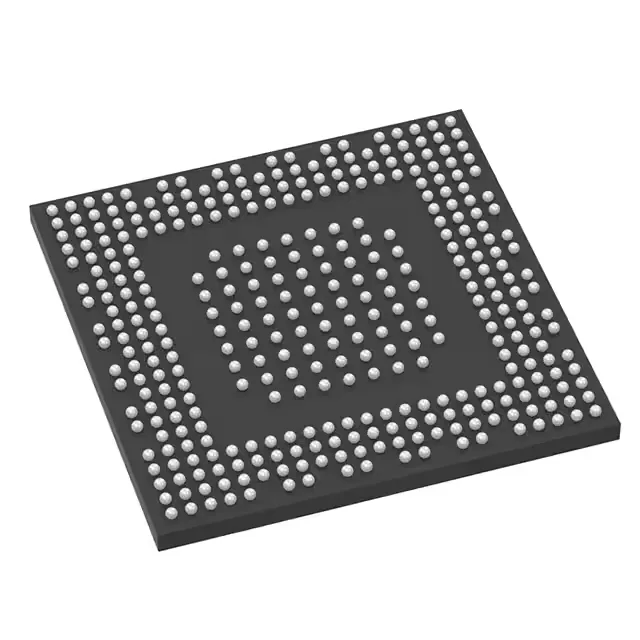
The 361-TFBGA (12x12 mm) package with 0.5 mm ball pitch requires a standard 4-layer PCB fan-out — no exotic via-in-pad or microvia process needed.