Dual-core architecture for mixed control and application processing
The STM32MP153CAC3 pairs a 650 MHz ARM Cortex-A7 application core with a 209 MHz Cortex-M4 real-time coprocessor, giving you a single chip that runs Linux on the A7 while the M4 handles deterministic control loops or sensor fusion without jitter from the OS scheduler. With 2 cores and a 32-bit bus width, the A7 side delivers the throughput for HMI graphics or networking stacks, while the M4 offloads time-critical I/O — a common split in industrial gateways and edge controllers where one processor handles the protocol stack and the other manages the fieldbus cycle.
Memory interface and peripheral budget for system integration
The integrated memory controller supports DDR3, DDR3L, LPDDR2, and LPDDR3, giving you the flexibility to match the DRAM cost and power profile to the application — LPDDR2 for battery-backed designs, DDR3L for standard industrial boards where 1.35 V saves thermal budget over 1.5 V DDR3. On the peripheral side, you get dual USB 2.0 host ports plus three USB 2.0 OTG PHYs, a 10/100 Mbps Ethernet MAC, CAN, multiple SPI/I²C/UART interfaces, and MMC/SD/SDIO for storage — enough connectivity to serve as the central processor in a multi-protocol industrial gateway without external USB hubs or PHY chips. The display and interface controllers include HDMI-CEC and LCD support, and the part carries hardware graphics acceleration — meaning you can drive a local touchscreen HMI directly from the chip without a separate GPU, keeping the BOM count down in panel-mount terminals.
Industrial temperature grade and security features for field deployment
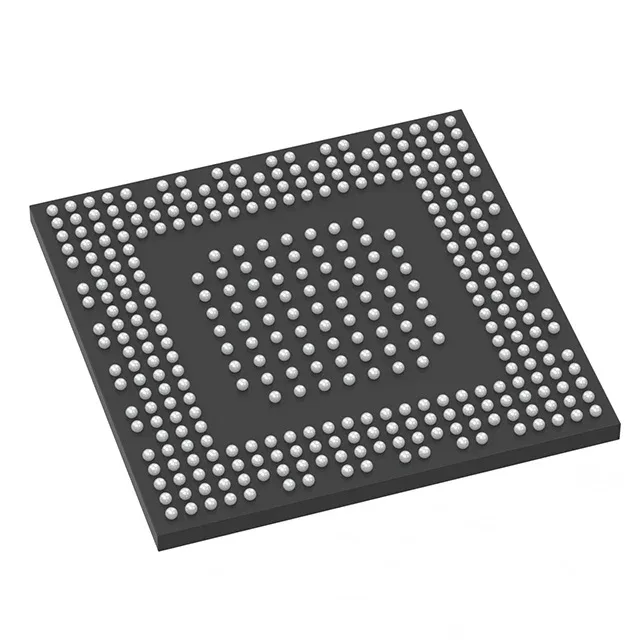
ARM TrustZone (ARM TZ) hardware security isolates the secure boot, key storage, and cryptographic operations from the main OS — essential for applications that need to protect firmware integrity or authenticate field-replacement modules without a dedicated secure element. The 361-TFBGA (12x12 mm) package requires a multi-layer PCB for fan-out — the 0.50 mm ball pitch means the inner rows need via-in-pad or microvias; budget for an 8-layer stack-up if you are routing DDR3 at full speed alongside the Ethernet and USB differential pairs.