170 MHz Cortex-M4F with math accelerator
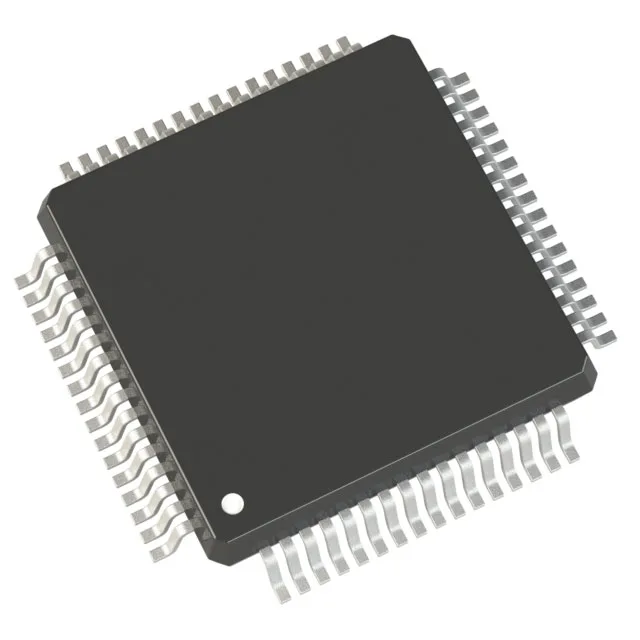
The STM32G474RCT6: That 170 MHz clock puts it in the upper tier of the STM32G4 series — enough headroom for a motor-control loop running at 20 kHz with space left for the comms stack and safety diagnostics. It carries 256 KB of flash and 128 KB of SRAM, which is a balanced split for a mixed-signal control application: the firmware image fits in the flash with room for a bootloader and parameter tables, while the RAM handles the real-time data buffers without spilling into external memory.
Analog front-end: 26 ADC channels, 7 DAC channels
The data-converter block on this part is unusually dense for a 64-pin MCU: 26 channels of 12-bit ADC and 7 channels of 12-bit DAC. That many analog inputs means you can monitor multiple current-sense resistors, thermistors, and voltage dividers without multiplexing externally — the on-chip sequencer handles the scan. The 7 DAC outputs can generate analog setpoints or bias voltages directly, saving an external DAC IC on the BOM.
Connectivity and I/O for fieldbus and sensor networks
The peripheral set includes CANbus, I²C, SPI, UART/USART, and QSPI — the QSPI interface is useful for attaching an external serial flash or FRAM for data logging without tying up the main SPI bus. The 52 I/O pins in the 64-LQFP package give enough GPIO for a keypad, encoder inputs, and a parallel LCD if needed, though the LQFP footprint limits breakout to a 4-layer board for dense routing. Temperature range is -40°C to 85°C, which covers industrial enclosures and outdoor cabinets but stops short of the 105°C or 125°C grades needed for under-hood automotive or downhole tools. For a motor drive or PLC module sitting in a ventilated panel, this is the standard industrial band.
Active production, ROHS3, and sourcing posture
The base product number is STM32G474, so the same silicon die is available in different package and memory variants across the STM32G4 family. If the 64-LQFP footprint is tight, the same MCU core is offered in a 48-pin or 100-pin package under the same series.