1.8 V fixed rail, 800 mA ceiling — the dropout and thermal reality
The LD1117S18TR is a single-output positive LDO from ST’s LD1117 family, delivering a fixed 1.8 V at up to 800 mA continuous. That 800 mA is the absolute ceiling at the rated dropout — the SOT-223 package’s junction-to-ambient thermal resistance means the real usable current depends on board copper and airflow. At 800 mA with a 1.2 V dropout max, the internal pass element dissipates nearly 1 W; without a decent ground-plane pour under the tab, the junction hits the 125°C limit well before the load does.
Dropout voltage and input headroom
Maximum dropout is 1.2 V at the full 800 mA load.
75 dB of ripple rejection at 120 Hz means the output sees about 178 µV of ripple for every 1 V of input ripple at that frequency — the attenuation factor is roughly 5600:1. That is the full-wave rectifier fundamental; if the upstream supply is a linear bulk regulator or a transformer-rectifier-capacitor front end, the 120 Hz component is the dominant noise. For a 1.8 V rail feeding an analog front-end or a PLL, this PSRR figure is the first line of defence against hum.
Protection features and quiescent draw
Built-in over-current and over-temperature protection mean the part folds back or shuts down before it self-destructs on a shorted output or a lost heatsink. The quiescent current is 10 mA — this is not a micropower LDO; a battery-powered device that spends most of its time in sleep should look at the LD1117’s lower-Iq siblings or a dedicated low-Iq regulator. For always-on 1.8 V rails in line-powered equipment, 10 mA Iq is negligible.
Package and board integration — SOT-223
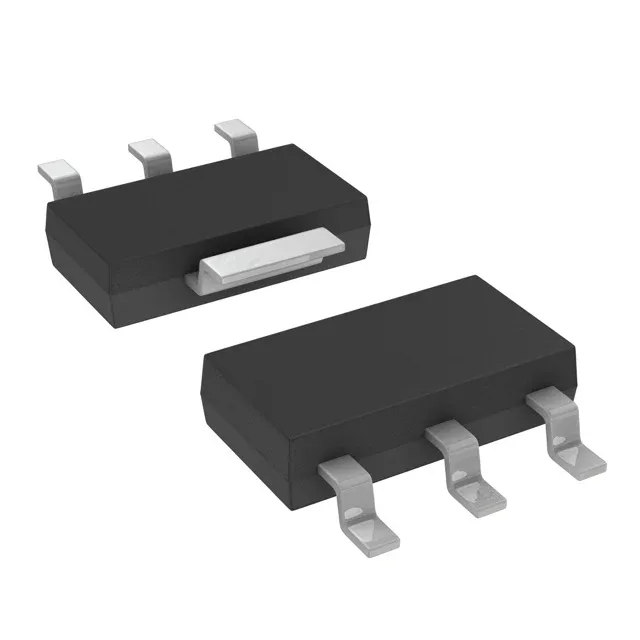
The SOT-223 (TO-261-4, TO-261AA) package has a large tab on the bottom that is the output (Vout) node. The tab must be soldered to a copper pad with thermal vias to the inner ground plane — the datasheet’s thermal resistance figures assume that pad. Without it, the junction-to-ambient thermal resistance climbs above 150°C/W, and the 800 mA rating becomes academic above 50°C ambient. The footprint is standard SOT-223; the centre pin is the tab, pin 1 is the adjust (fixed here, so tied to ground or left open per the fixed-output configuration), pin 2 is Vout, pin 3 is Vin.