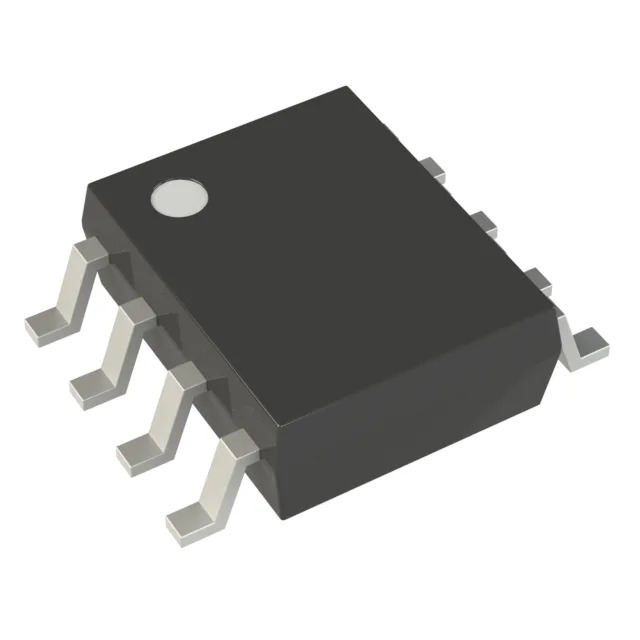
3.3V fixed LDO for breadboard-friendly power rails
The STMicroelectronics LD1117D33TR is a single-output, 3.3V fixed positive LDO regulator in an 8-SOIC package. It delivers up to 800 mA with a maximum dropout of 1.2V at full load, making it a solid choice for powering 3.3V logic, sensors, or small microcontrollers from a 5V or 12V rail. Operating temperature spans 0°C to 125°C, so it's fine inside a warm enclosure but not for outdoor gear that sees freezing starts.
Dropout and headroom — what the 1.2V max means on your rail
The 1.2V dropout at 800 mA is typical for an NPN-pass LDO — it needs about 1.5V of headroom to regulate cleanly. On a 5V input you'll get a solid 3.3V out, but a 3.6V rail (like a Li-ion battery near end-of-charge) won't leave enough margin; the output will track the input minus dropout. For low-dropout applications, a CMOS LDO like the LD39020DTPU33R (200 mA, 80 dB PSRR) might be a better fit, though at a fraction of the current.
Protection and quiescent draw
Built-in over-current and over-temperature protection mean the part won't self-destruct under a short or a stalled fan — it folds back or shuts down until the fault clears. Quiescent current sits at 10 mA, which is high by modern LDO standards; if your project runs on battery, the 10 mA Iq will drain a cell overnight. This part is better suited to line-powered or always-on industrial boards where the quiescent draw is a rounding error on the total budget.
Package and soldering — hand-solderable SOIC-8
The 8-SOIC package with 1.27 mm pitch is easy to hand-solder with a fine iron and some flux — no hot-air gun required. The 0.154" body width fits standard SOIC footprints, and the exposed pad (if present on the die attach) isn't a power-dissipation requirement at 800 mA, but a small via stitch under the part helps keep the junction cool if you push it near the limit.
The LD1117 base number is a long-running ST family with broad distribution coverage — you'll find it at multiple independent and authorized channels.