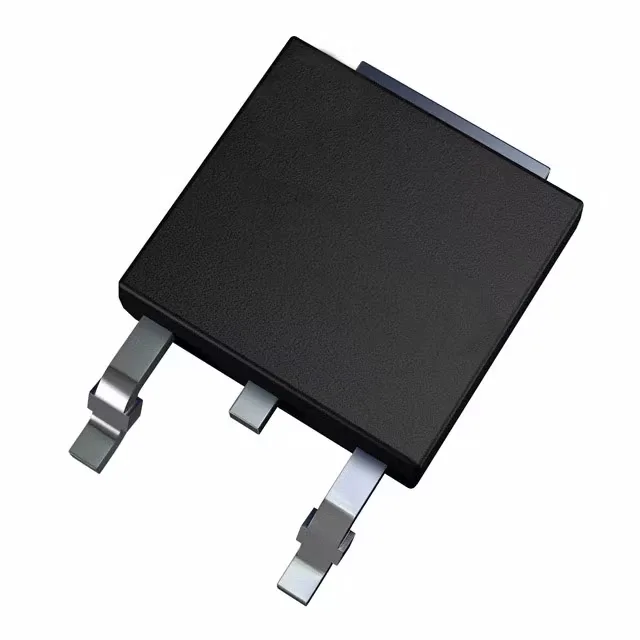
3.3V fixed LDO with 500mA output and 0.7V max dropout
The KF33BDT-TR is a single-output positive LDO from STMicroelectronics, delivering a fixed 3.3V output at up to 500mA continuous current. Maximum dropout voltage is 0.7V at the full 500mA load, so the input rail needs at least 4.0V to keep the output in regulation across temperature and load — nominal is not absolute max, and the 20V input maximum on page 1 of the datasheet gives plenty of headroom for 5V or 12V rails. Quiescent current is 1 mA typical, rising to 12 mA max under heavy load — the 1 mA Iq floor is low enough for always-on auxiliary rails in industrial control or automotive body modules, but the 12 mA supply-current ceiling means this is not a micropower LDO for battery-sleep applications.
PSRR vs frequency — where the noise rejection lives
Power-supply rejection ratio is specified at 80 dB at 120 Hz, rolling off to 60 dB at 10 kHz. The 80 dB figure at line frequency (100/120 Hz) means ripple from a mains-rectified front end is attenuated by a factor of 10,000 — a 100 mV p-p ripple on the input becomes 10 µV at the output. Above 10 kHz the rejection drops, so upstream switching regulators running at 100 kHz+ will push noise through unless the LDO is followed by a low-ESR ceramic output cap or an additional LC filter. The PSRR curve is a single-pole roll-off typical of LDOs with a PMOS pass element — the bandwidth of the error amplifier sets the crossover. For a 3.3V rail powering an analog front-end (e.g., an ADC reference buffer), the 60 dB floor at 10 kHz still provides 1000:1 rejection of the switching regulator's fundamental.
DPAK package and board-fit for 500mA thermal budget
Housed in the TO-252-3 DPAK (DPak, 2 leads plus tab), the KF33BDT-TR's exposed copper tab on the bottom is the primary thermal path — the junction-to-ambient thermal resistance depends on the PCB copper area soldered to the tab. For 500mA at 3.3V output from a 12V input, the power dissipation is roughly 4.35W (12V − 3.3V × 0.5A), which demands a substantial copper pour on the board's bottom layer or a heatsink. The DPAK footprint is standard; the tab is internally connected to ground (the output is positive, but the tab is the substrate, typically tied to the most negative potential). The protection block includes over-current and over-temperature shutdown — the LDO folds back or latches off before the die exceeds the 150°C typical thermal limit.
The tape-and-reel packaging (TR suffix) is the standard reel format for automated pick-and-place; the same die in tube or cut-tape is covered by the sibling order code KF33BD-TR (non-tape-and-reel). The two are electrically identical — same 3.3V fixed output, same 500mA rating, same PSRR and dropout — differing only in the shipping media.