What the boost topology and 6-channel output mean for a backlight design
The BD9470AEFV-E2: The BD9470AEFV- is a step-up (boost) DC-DC regulator LED driver from ROHM, built for backlight applications. Its six regulated outputs each source up to 250 mA, and the internal switching FET handles the boost conversion at 150 kHz — no external switch transistor needed. Because the part integrates the switch and runs a fixed 150 kHz oscillator, the external BOM stays small: one inductor, a Schottky diode, and a handful of ceramic caps. The PWM dimming input lets a controller or GPIO set brightness directly without an external DAC.
Package, footprint and rework considerations
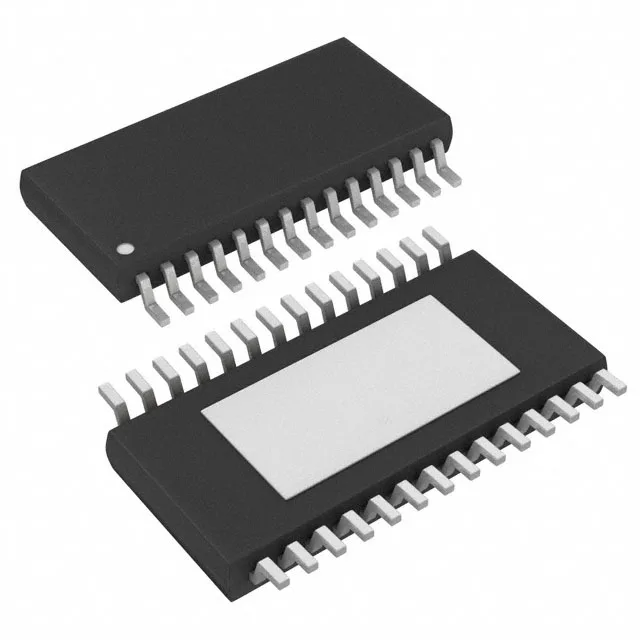
Housed in a 28-VSSOP with exposed pad (0.173" body, 4.40 mm width), the supplier device package is designated 28-HTSSOP-B. The exposed pad on the underside must be soldered to a thermal land on the PCB to pull heat from the internal switch — a four-layer board with thermal vias under the pad keeps the junction below the 85 °C ambient ceiling. The pad is large enough that a hot-air rework station can lift the part cleanly if the board is pre-baked per J-STD-033 for the MSL level.
Supply voltage range and output current per channel
Input supply spans 9 V to 35 V, covering common backlight rails from a 12 V regulated bus up to a 24 V industrial supply. Each of the six channels is rated for 250 mA continuous — total output power is limited by the boost converter's duty cycle and the inductor saturation current, not by the per-channel rating alone. At 150 kHz switching, the inductor ripple current is manageable with a 22 µH to 47 µH shielded inductor. The PWM dimming frequency should stay below 1 kHz to avoid audible coil whine from the inductor; the internal oscillator does not synchronise to an external clock.
No official successor or pin-compatible cross-reference is listed in the ROHM portfolio.