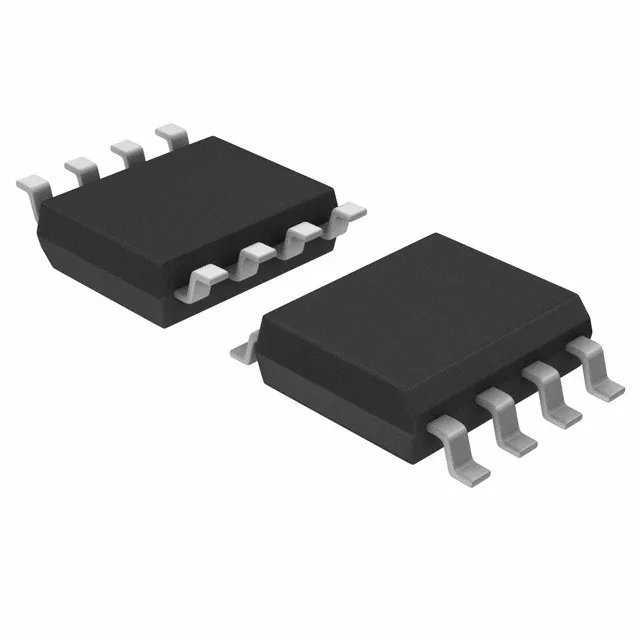
Renesas Electronics ZSC31015EAG1-R — Logic ICs

ZSC31015EAG1-R RBicLite™ Sensor Signal Conditioner, 2.7V-30V

MPNZSC31015EAG1-R
End of Life

Renesas RBicLite™ ZSC31015EAG1-R, Sensor Signal Conditioner - Resistive, 2.7V ~ 30V supply, ZACwire™ One-Wire Interface, 8-SOIC (0.154", 3.90mm Width), Surface Mount, Tape & Reel.

$6.08Ref. price · indicative, final on quote
Packaging8-SOIC (0.154", 3.90mm Width)
StockContact for availability
MOQ1 pcs
  • 100% new & originalTraceable channels only — no refurbs, no pulls, no remarked parts.
  • Date & lot codes on quoteStated per line before you commit; label photos on request.
  • MSL-compliant ESD packingMoisture-sealed bags with indicator cards; reels photo-verified.
  • PayPal buyer protectionPay by T/T, PayPal or Payoneer — card payments covered end to end.

Specifications

ZSC31015EAG1-R Technical Specifications
ParameterValue
SeriesRBicLite™
Mounting typeSurface Mount
Voltage2.7V ~ 30V
InterfaceZACwire™ One-Wire Interface
PackageTape & Reel (TR); Cut Tape (CT)
ApplicationsSensor Signal Conditioner - Resistive
Case8-SOIC (0.154\", 3.90mm Width)

Product details

Wide-rail signal conditioner for bridge sensors

The Renesas ZSC31015EAG1-R is a RBicLite™ series resistive sensor signal conditioner designed to linearize, amplify, and digitize outputs from resistive bridge sensors — think pressure transducers, load cells, and strain gauges. Its standout feature is the 2.7V to 30V supply range, which lets it run directly off an unregulated industrial 24V rail or a multi-cell Li-ion battery without a front-end regulator. The ZACwire™ one-wire interface handles both programming and digital readback on a single pin, saving an MCU GPIO and simplifying galvanic isolation.

That 2.7V minimum means the part stays alive through a battery's end-of-life voltage, and the 30V ceiling covers a 24V nominal rail with margin for transients. You can drop the dedicated LDO or DC-DC that a 3.3V-only conditioner would need — one less inductor, one less ceramic cap. The wide supply also simplifies reverse-polarity protection: a single series diode still leaves enough headroom for the conditioner to operate. No exposed pad means no via-stitch thermal management, but the part's quiescent draw is low enough that dissipation isn't a concern at room temperature.

ZACwire one-wire: firmware and layout notes

The ZACwire interface is a single-wire bidirectional protocol — the host MCU sends commands and receives data on the same line. The firmware engineer needs to budget for a bit-banged UART or a dedicated timer capture/compare channel; there's no hardware ZACwire peripheral on most MCUs. On the PCB, keep the trace short and avoid routing it near a switching node to preserve signal integrity during programming.

Frequently asked questions

What is ZSC31015EAG1-R used for?

It is a resistive sensor signal conditioner — it linearizes, amplifies, and digitizes the output of resistive bridge sensors such as pressure transducers, load cells, and strain gauges. The digital output is read over the ZACwire one-wire interface.

Is ZSC31015EAG1-R obsolete?

No — the part is listed with an Active product status.

What are the alternatives for ZSC31015EAG1-R?

The closest functional alternative is the ZSC31050FIG1-R from the same RBicLite family. It adds AEC-Q100 automotive qualification and supports I²C and SPI interfaces in addition to ZACwire. For non-automotive designs that only need ZACwire, the ZSC31015EAG1-R is the simpler, lower-cost choice.

How to program ZSC31015EAG1-R?

Programming is done over the ZACwire one-wire interface. A host MCU sends configuration commands (gain, offset, linearization coefficients) and reads back the conditioned digital output on the same pin. Renesas provides application notes and a programming guide for the register set.