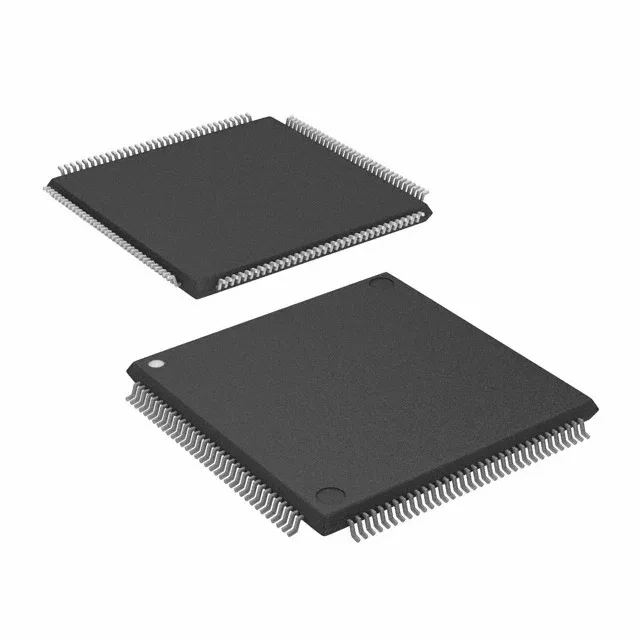
What the 50 MHz core and 1 MB Flash mean for the BOM
The MC9S12XEP100CAG: This is the high-density member of the HCS12X family, with 1 MB Flash and 64K x 8 RAM. The 50 MHz core speed sets the bus timing for the external memory interface (EBI/EMI) and the CAN controller. At this clock rate, the XGATE co-processor (part of the HCS12X core) can handle interrupt-driven tasks like CAN message filtering or PWM updates without loading the main CPU — a feature that matters when you are sizing the interrupt latency budget for a real-time control loop.
The supply range from 1.72 V to 5.5 V on Vcc/Vdd is unusually wide for a 50 MHz MCU.
Industrial temperature grade and peripheral mix
The 24-channel 12-bit ADC covers analog inputs like thermocouples or potentiometer feedback without an external converter. The 4 KB EEPROM is mapped into the memory space, so calibration constants or production data survive a firmware update without wearing the Flash. The LVD and POR peripherals are built in, reducing external supervisor IC count.
Package and PCB layout notes
The 119 I/O means dense routing on the inner layers — expect at least four signal layers for a design using the full EBI/EMI bus. The exposed pad (if present in this variant) should be stitched to the ground plane with thermal vias; the datasheet's thermal resistance numbers assume that path.
The HCS12X series has been in production for over a decade, which means the toolchain (Freescale/NXP CodeWarrior for HCS12) is mature and the application notes are extensive.