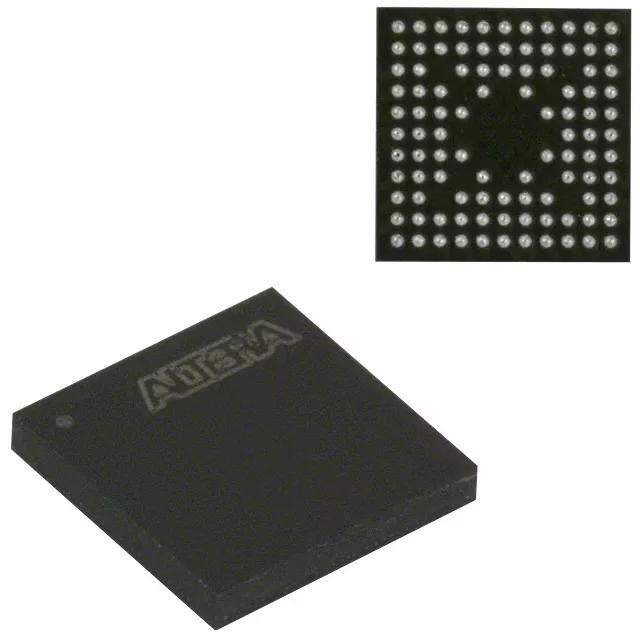
440 macrocells in a 6x6 mm BGA — where the MAX II fits
The Intel EPM570M100C4N is a MAX II family CPLD packing 440 macrocells and 570 logic elements into a 100-ball MBGA package measuring 6x6 mm. That density-to-footprint ratio makes it a candidate for glue-logic consolidation on space-constrained boards where a larger TQFP or a separate FPGA would overhang the keep-out zone. With 76 user I/O and a propagation delay of 5.4 ns max (tpd1), it handles address decoding, state-machine sequencing, and bus interface translation at typical system clock rates up to about 100 MHz — the pin-to-pin delay sets the combinatorial logic ceiling, not the register toggle rate.
Dual-rail supply and in-system programming
The core runs on 2.5 V while the I/O banks accept 3.3 V, so it interfaces directly with 3.3 V peripherals without an external level shifter. In-system programmability via JTAG means the device can be programmed after soldering, which simplifies rework and field updates. The C4N speed grade (the '4' in the ordering code) corresponds to the 5.4 ns tpd — the 'N' suffix indicates lead-free (RoHS-compliant) finish.
Commercial temp range and active lifecycle
For extended or industrial temperature ranges, the 'I' grade variant (EPM570M100I5N) would be the alternative — the '5' denotes a 5.4 ns tpd with a wider temperature envelope.