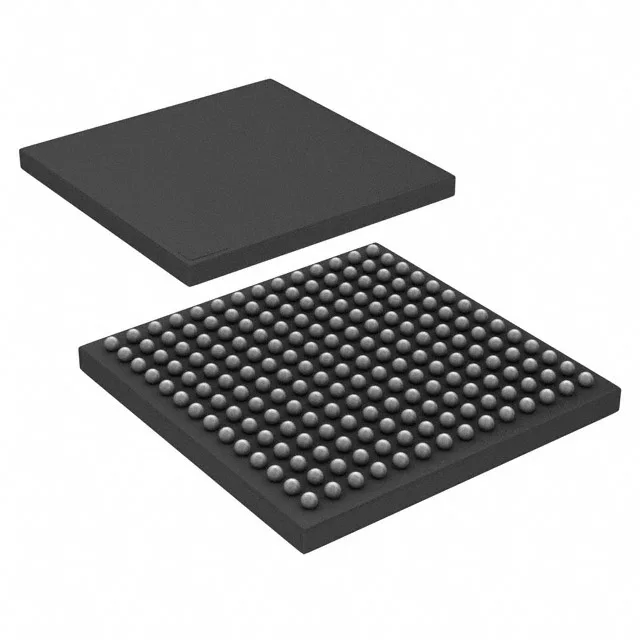
Active production — BOM-fit for entry-level Spartan-7 designs
The XC7S15-1FTGB196C: RoHS3 compliant, with no exempt lead in the solder balls, so the assembly process uses SAC305 or equivalent Pb-free alloy.
12,800 logic cells and 360 Kbit block RAM — the gate-count ceiling
12,800 logic elements/cells and 368,640 total block RAM bits define the resource budget for this entry-level Spartan-7 device. The 1,000 LABs/CLBs give the synthesis tool roughly 12 LUTs per LAB for glue logic, state machines, or small DSP datapaths. The 360 Kbit block RAM fits a single 32 K x 9 or 16 K x 18 buffer — enough for one Ethernet frame buffer or a small coefficient table, but not for full-frame video line storage.
100 I/O in a 196-ball 15x15 mm CSBGA means 96 balls are dedicated to power, ground, configuration, and clock — the I/O-to-ball ratio is about 51%. The 0.8 mm ball pitch demands a minimum 4-layer PCB for fan-out; a 2-layer board will not route all 100 I/O without buried vias. The 0.95 V to 1.05 V core supply requires a 1.0 V nominal rail held within ±50 mV under load transients — a standard 1.0 V LDO or switching regulator with remote sense is adequate, but the PCB trace resistance from regulator to BGA balls must stay below 5 mOhm to avoid IR drop.
Commercial temperature grade — indoor deployment only
Operating temperature range is 0°C to 85°C junction — this is the commercial (non-industrial) grade. The device is not rated for extended ambient above 70°C or for cold start below freezing, so deployment is limited to controlled indoor environments such as lab equipment, testers, or telecom central offices.