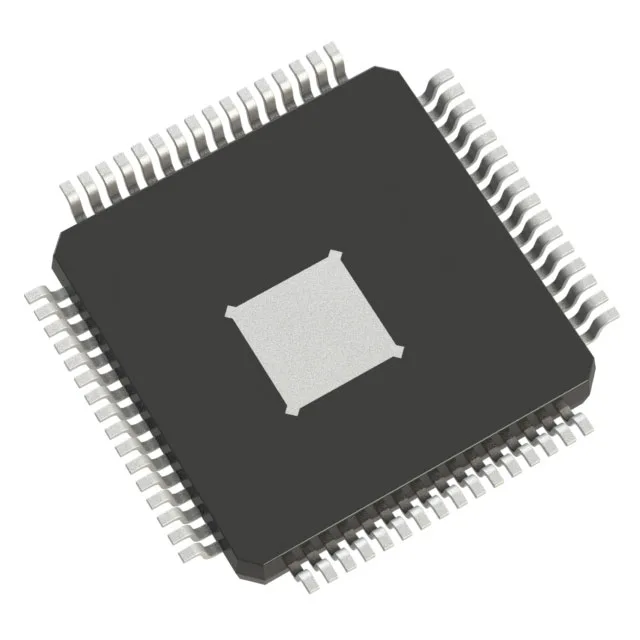
48 MHz Cortex-M0 with 128 KB flash — what the memory and speed budget means for your firmware
The XMC1402F064X0128AAXUMA1 is an Infineon XMC1000 series microcontroller built around an ARM Cortex-M0 core running at 48 MHz. It carries 128 KB of on-chip flash and 16 KB of SRAM — enough for a moderate control loop with a sensor-fusion stack, a communication protocol buffer, and a few hundred lines of application code without external memory. The 48 MHz clock ceiling is set by the internal oscillator — no external crystal is required for the core, though the I2S peripheral may need one for audio-grade clocking. The 16 KB SRAM (organized as 16K x 8) leaves room for a modest RTOS heap and a few packet buffers; if your application needs more than that for data logging or a display frame buffer, you will hit the RAM wall before the flash.
Peripheral set and connectivity — what is on-chip and what needs external logic
The XMC1402 integrates a 12-channel 12-bit ADC, PWM timers, a watchdog timer, brown-out detect, power-on reset, and an I2S interface for audio or serial data streaming. For communication it has I2C, SPI, UART/USART, and LINbus — enough for a sensor hub talking to a host over a fieldbus or a simple CAN gateway (though CAN itself is not on-chip; that would need an external transceiver and the LIN peripheral repurposed). If you need precise timing for the I2S or a baud-rate generator, an external resonator or crystal can still be connected to the dedicated oscillator pins — the internal RC is trimmed to ±1 % accuracy over temperature, which is adequate for most UART and SPI rates.
The tape-and-reel packaging (also available in cut tape) suits both prototype assembly and volume production.