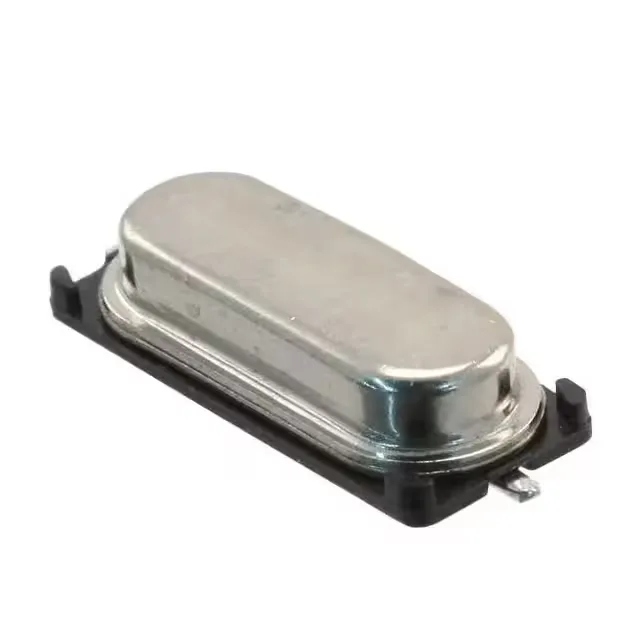
16 MHz and what the ESR means for your clock circuit
The ECS-160-18-5PVX-GN-TR: 16 MHz fundamental mode — the frequency that defines the timing budget for the microcontroller clocks, UART crystals, and reference oscillators where this crystal sits. At 16 MHz the 50 Ohm ESR is the figure that governs drive level and startup reliability, not the ESR itself — the ESR tells you whether your oscillator circuit can deliver sufficient startup energy within the crystal's drive-level rating.
HC-49/US SM package and surface-mount reality
The HC-49/US SM is the Gull-wing surface-mount variant of the classic through-hole HC-49 profile, not the short-barrel HC-49S. It ships in tape and reel for automated pick-and-place, with the standard HC-49 silhouette still dominating board-level footprints in industrial and consumer applications.
Stability, tolerance, and where the ±30 ppm sits
±30 ppm total tolerance — the combined initial tolerance plus aging allowance — means the 16 MHz output can drift up to ±480 Hz from nominal across the operating life. For a UART or embedded microcontroller clock this sits well within the timing margin; for a precision frequency reference or long-stream protocol the accumulated drift across temperature matters and a tighter-stability variant earns its cost. The 18 pF load capacitance must be matched by the oscillator circuit — a mismatched CL causes the crystal to run off-frequency from first power-up.
Sourcing posture and availability
Listed Active by ECS Inc. — confirmed in production with standard lot traceability through the franchised channel.