14.31818 MHz — the PC/AT color-burst clock
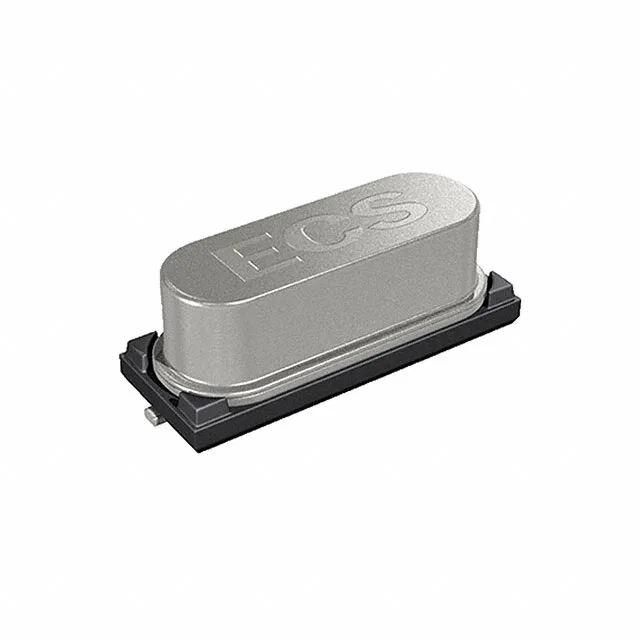
The ECS-143-20-5PX-TR: The 14.31818 MHz frequency is no accident — it is exactly 4× the NTSC color subcarrier (3.579545 MHz) and the bus clock on the original IBM PC/AT. Crystals at this frequency drive video timing circuits, UART clock trees, and any legacy embedded system that inherited the PC/AT clock topology. If your board needs a tight tolerance reference at this frequency, this is the part that fits that slot. The HC-49/US package in surface-mount form sits on a 11.40 mm × 4.80 mm footprint. The body height is 4.30 mm seated. Solder pad layout follows the standard three-point lead formation — the two outside leads carry the crystal, the centre pad is mechanical reference only and should not be electrically tied.
Total frequency budget: ±80 ppm at the system level
The datasheet separates tolerance (±30 ppm,) from stability (±50 ppm,) — added together, the combined budget is ±80 ppm at room temperature before you account for board-level loading. Your PLL or counter-divider will multiply this error by the division ratio, so a ×4 clock chain turns a ±80 ppm crystal error into ±320 ppm at the divided output. Budget accordingly. Load capacitance is specified at 20 pF. The crystal sees the series combination of the driver output capacitance, the PCB trace capacitance, and the pin parasitic — if the actual total load strays from 20 pF, the oscillation circuit pulls the frequency. Check your MCU oscillator section for the recommended CL value; mismatched load capacitance is the most common reason a crystal that passes manual test fails on the first board spin. Equivalent series resistance is 40 Ω maximum. This sets the drive level required from the oscillator circuit — a high-ESR crystal in a circuit designed for a 25 Ω part will start slowly or not at all in cold conditions. Most modern MCU oscillator circuits are forgiving to 60 Ω, but confirm against the oscillator design guide if your system must start below 0 °C.
Commercial temperature grade limits the application
The operating range is −10 °C to +70 °C — this is a commercial-grade crystal, not an industrial or automotive part. Above 70 °C the frequency stability is not characterized, and the aging rate accelerates significantly. Do not specify this part for outdoor enclosures, engine-adjacent boards, or any deployment that regularly exceeds room temperature by more than 20 °C without a derating conversation with your ECS rep.