Frequency tolerance and stability — the clock accuracy budget
The ECS-240-20-19A-TR: For a microcontroller UART running at a standard baud rate, that drift sits well within the comfortable margin for most asynchronous protocols at 115200 baud and below, but a precision timing loop or a USB PHY that relies on tight baud-rate accuracy may need the external capacitors trimmed to pull the crystal closer to nominal. Load capacitance is specified at 20 pF — the PCB layout must present this total capacitance to the crystal pins, which means the external series capacitors are sized accounting for the device pin capacitance and board trace capacitance in addition to the 20 pF load target.
Commercial temperature grade and ESR
The -10 °C to +70 °C operating window is the commercial (C-grade) band — suitable for indoor instrumentation, consumer equipment, and most portable devices that live in conditioned environments. It is not the industrial -40 °C floor, so a product that needs to cold-soak or operate in an unheated enclosure should verify that the application ambient stays within this range or select a C-grade crystal with an extended temp option. ESR is listed at 50 Ω — the series equivalent resistance at the fundamental frequency. A higher ESR means slightly more drive power is needed from the oscillator circuit to sustain oscillation, and it affects the start-up time. For most microcontroller oscillator blocks, 50 Ω is well within the drive capability of the internal oscillator amplifier.
Package footprint and assembly compatibility
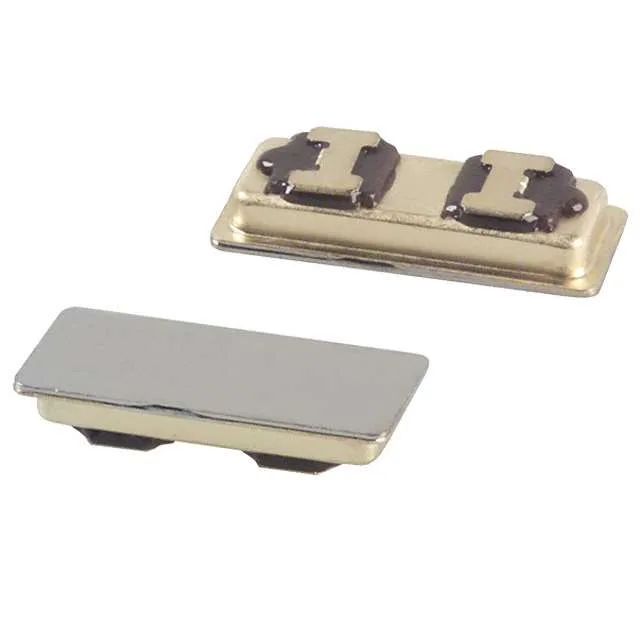
The no-lead (Gull-wing-free) terminations simplify paste-print and reflow alignment compared to ceramic leaded packages, and the low profile clears most standard socket headers without interference. Supplied on tape-and-reel cut tape, making it compatible with standard pick-and-place workflows without special feeder requirements. The standard 8 mm pitch carrier tape aligns with most SMT assemblers' default reel setup for this package family.