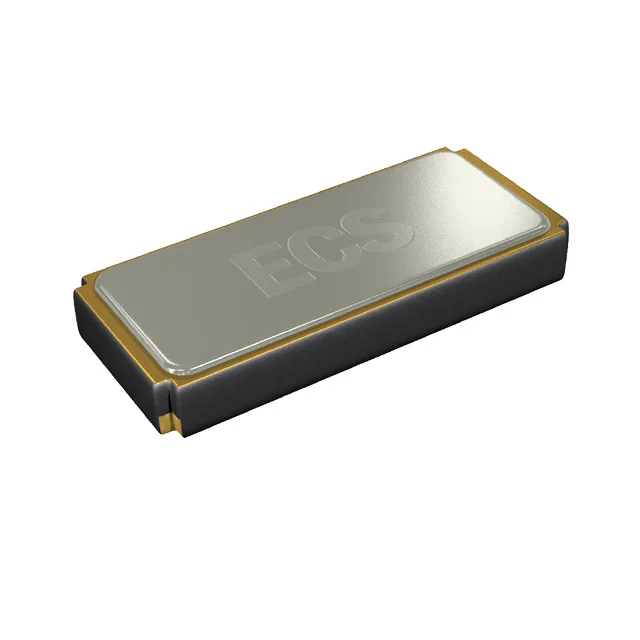
32.768 kHz tuning fork — what the tolerance and ESR mean
The ECS-.327-6-34G-TR: The 32.768 kHz fundamental-mode tuning fork is the standard RTC reference across microcontrollers from most major MCU families. At this frequency the ±20ppm tolerance band translates to a timekeeping error of roughly ±1.7 seconds per day — acceptable for most calendar and timestamp functions, but tighter than the ±30ppm units sometimes stocked as cost-down alternatives. The 70 kΩ ESR is the load the crystal presents to the oscillator circuit at resonance; a lower ESR reduces start-up time and power draw in the MCU's crystal oscillator pins, and the ECX-34G's ESR sits squarely in the normal range for a 6pF tuning fork of this size. Load capacitance of 6pF must match the oscillator circuit's external C-load budget — undershooting reduces the pullability range and can pull the crystal off frequency, while overshooting slows start-up. If the MCU datasheet calls for 12.5pF total load and the PCB traces add ~2pF each side, a 6pF crystal is the right match. Confirm the MCU's crystal oscillator specification before committing to the 6pF load rating on this part.
ECX-34G package — footprint and reflow profile
The flat landing pads suit standard SAC305 reflow profiles; no heel or side fillets to inspect on a no-lead device, so joint integrity relies on pad design and solder paste volume rather than toe fillet inspection. The ultra-low profile makes it viable for space-constrained wearable and portable boards where taller HC-49 or half-can packages won't fit. For outdoor or engine-adjacent RTC functions that push toward 105°C, a +125°C crystal grade would be needed — the ECX-34G's grade is not stated beyond 85°C, so a thermal survey of the enclosure is warranted if the board runs in a warm environment.
ECS Inc. lists this part as Active. It ships in Tape & Reel and Cut Tape, making it straightforward to procure by the full reel for production or as cut tape for prototype quantities.