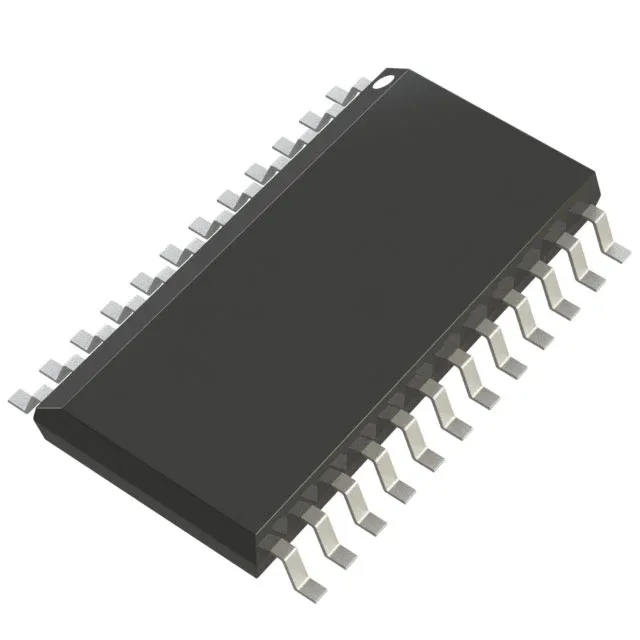
Quad 100kΩ digital pot — SPI-programmable analog trim in one package
The AD8403ARZ100-REEL is a quad-channel digital potentiometer from Analog Devices, packing four independent 100 kΩ resistor strings with 256 wiper tap positions each, controlled over a shared SPI bus. Each channel replaces a mechanical trimmer in volume control, programmable gain amplifier offset calibration, or sensor bias adjustment — the SPI interface keeps the wiper setting immune to the contact noise and wear that plague mechanical pots on a vibrating production line.
256 taps per channel — the resolution and the trade-off
256 taps across a 100 kΩ end-to-end resistance gives a step size of roughly 390 Ω per tap (100 kΩ / 256). The wiper resistance is 200 Ω typical, which adds a fixed offset at the zero-scale end — the effective minimum resistance between wiper and B terminal is 200 Ω, not zero. The 500 ppm/°C temperature coefficient means the absolute resistance drifts about 50 Ω/°C. For an audio level-control application the drift is inaudible, but for a precision voltage divider feeding a 12-bit ADC the tempco should be budgeted into the system error stack. Tolerance is ±30 % on the end-to-end resistance — the absolute value varies part-to-part, but the ratiometric accuracy between taps is much tighter because the internal resistor-string matching is laser-trimmed. This is typical for digital pots used as voltage dividers rather than variable resistors.
Volatile memory — the boot-time initialization requirement
The wiper positions are volatile — on power-up the AD8403 resets to the mid-scale position (tap 128), and the host MCU must write the desired wiper codes over SPI before the analog path is enabled. The cascade pin (pin 3) allows daisy-chaining multiple AD8403 devices on a single SPI bus — the serial data output of the first device feeds the SDI of the next, so a multi-channel system with 8, 12, or 16 pots uses only three MCU pins (CS, CLK, SDI). Because the memory is volatile, a brown-out or glitch on the supply rail resets the wipers to mid-scale — the system design should include a power-good monitor that forces a re-initialization sequence after any supply interruption.
Package and layout — 24-SOIC wide-body footprint
Housed in a 24-SOIC wide-body package (7.50 mm body width, 1.27 mm lead pitch), the AD8403ARZ100-REEL uses the standard SOIC-24W footprint — the 1.27 mm pitch routes easily on a 2-layer board without blind vias. No exposed thermal pad — the die heat dissipates through the leadframe and copper traces. For a digital pot drawing microamps of supply current, thermal management is not a concern, but the wide-body package gives better clearance for high-voltage signal routing on adjacent layers. Supplied on tape and reel (2,500 pieces per reel) for automated pick-and-place assembly; cut-tape quantities are also available for prototype runs.
Active lifecycle — no EOL watch required
No stock-holding claim — each RFQ is quoted fresh.