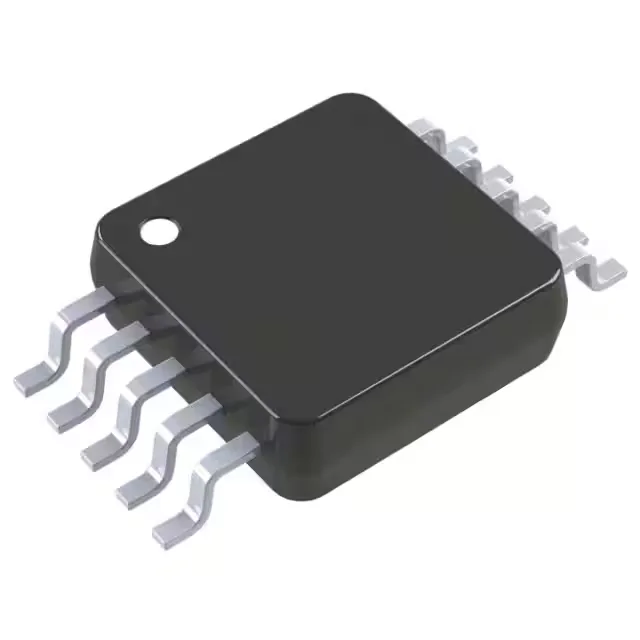
The AD5161BRMZ100 is a 100 kΩ single-channel digital potentiometer with 256 tap positions, packaged in a 10-MSOP. It replaces a mechanical trim pot in applications where a microcontroller sets the resistance digitally — no screwdriver, no drift over time. The linear taper means the wiper resistance changes linearly with the digital code, unlike a log-taper part for audio volume. The 50 Ω typical wiper resistance adds a small offset at the low end — a 256-step sweep from 0 to 100 kΩ starts at 50 Ω, not zero. The ±30% resistance tolerance is typical for a digital pot — the end-to-end resistance can vary from 70 kΩ to 130 kΩ across parts, but the ratiometric accuracy (the tap-to-tap matching) is much tighter, which is what matters when the pot is used as a voltage divider.
Interface and memory type
The AD5161BRMZ100 supports both I²C and SPI interfaces — the part auto-detects the protocol on power-up. This dual-interface flexibility means it can drop into a design using either bus without a separate protocol translator. Memory is volatile: the wiper position resets to mid-scale (tap 128) on power-up and is lost when the supply drops. If the application needs to retain the wiper setting through a power cycle, an external EEPROM or a non-volatile digital pot (like the AD5160 family) is the alternative. The cascade pin allows multiple AD5161 devices to be daisy-chained on the same SPI bus, each responding to its own chip-select or address. The selectable address feature on the I²C interface lets up to four devices share the same bus by setting the address pins.
Package, footprint, and reflow considerations
The 0.50 mm pitch demands a controlled solder-paste stencil — a 0.25 mm aperture with a 1:1 aspect ratio is a safe starting point. Surface-mount assembly with a standard lead-free reflow profile (peak 260 °C) is fine — the MSOP body is thin and the exposed pad is absent, so tombstoning risk is low as long as the pad geometry is symmetrical. No special bake required unless the part has been exposed to ambient humidity beyond the MSL floor life. The tube packaging (50 parts per tube) is the standard for prototype and low-volume builds. For reel packaging, the sibling AD5161BRMZ100-RL7 ships in tape-and-reel — same die, same package, just different logistics for pick-and-place.
Temperature range and compliance
The 45 ppm/°C typical temperature coefficient means the resistance drifts about 4.5 Ω per °C — negligible for most trimming and adjustment circuits.