What the 9152 logic cells and 160 I/O mean for a board design
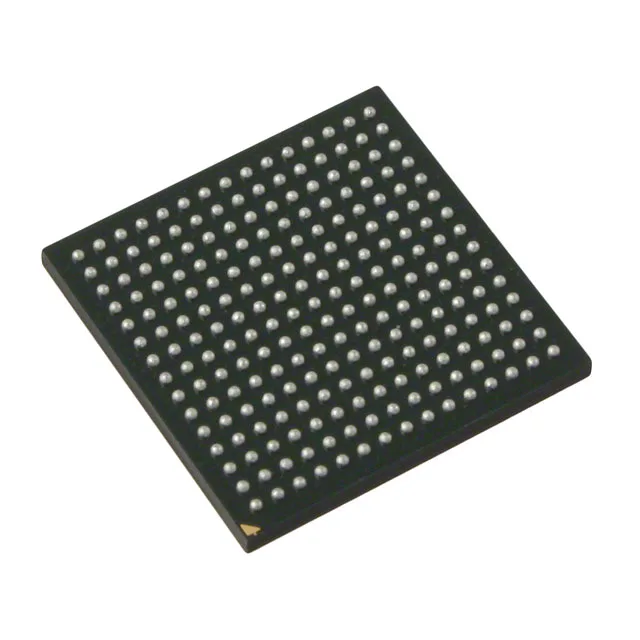
The XC6SLX9-2CSG225C: The 9152 logic elements and 715 LABs/CLBs give this Spartan-6 LX FPGA enough fabric for moderate glue logic, a soft-core microcontroller, or a few DSP slices — think a motor-control interface or a sensor-fusion engine that needs combinatorial depth, not a full video pipeline. The 589824 total RAM bits are split across block RAM tiles; that is about 72 KB of on-chip memory, enough for a small frame buffer or coefficient storage without an external SRAM. With 160 user I/O in a 225-ball CSPBGA, the pinout is dense — expect to route at least four signal layers on the PCB to fan out the inner balls. The 13x13 mm body keeps the board footprint tight for a 9K-logic device.
Core voltage is 1.14 V to 1.26 V — a 1.2 V nominal rail with ±5 % regulation. Any switching regulator feeding this rail should stay within that window over load transients; the FPGA will not power up correctly outside it. The commercial temperature grade (0°C to 85°C junction) means this part is specified for indoor, conditioned environments — not for an outdoor base station or under-hood deployment. If the ambient near the FPGA exceeds 70°C, the junction will hit the ceiling.
This is not an NRND or EOL part — it remains in the current Spartan-6 LX portfolio for new and sustaining designs. RoHS compliance is confirmed as ROHS3 Compliant, covering the full six restricted substances plus the four phthalates. No exemption-laden earlier revision to track. No last-time-buy window to chase — the part is in active supply.