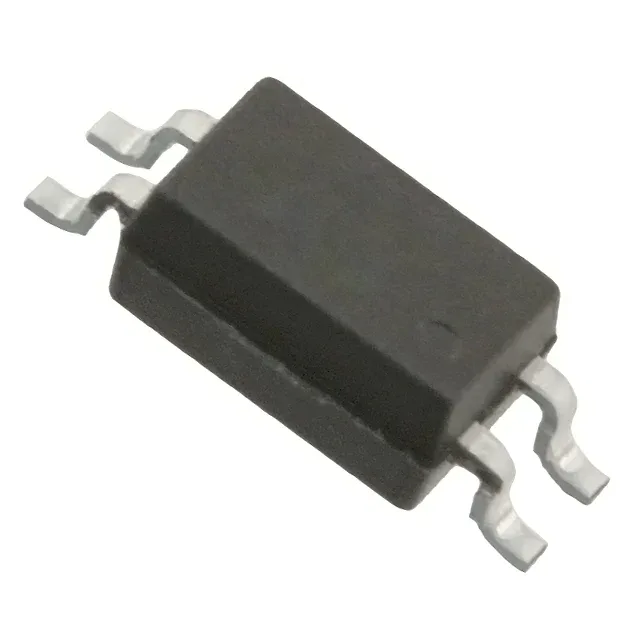
The TCMT1105 is a single-channel optocoupler from Vishay with a DC-input phototransistor output, packaged in a 4-SOIC (4.40 mm wide) surface-mount case. Its 3750Vrms isolation rating makes it a standard choice for galvanic isolation in industrial controls — PLC digital inputs, motor-drive feedback paths, and isolated DC-DC converter feedback loops. The transistor output can switch up to 70V and sink 50 mA, which covers most logic-level interface and low-power load switching needs.
CTR range and LED bias — the design decision
The current transfer ratio is specified at 50% minimum and 150% maximum, both measured at 5 mA forward current. That spread means the designer must size the LED series resistor so the phototransistor saturates at the worst-case 50% CTR. At 5 mA If, a 50% CTR gives 2.5 mA output drive — enough to pull a 10 kΩ pull-up to logic low, but marginal for a 1 kΩ load. The 1.35V typical forward voltage is standard for an IR LED and fits a 3.3V or 5V GPIO drive without a level shifter.
Rise and fall times are 5.5 µs and 7 µs typical; turn-on and turn-off times run 9.5 µs and 8.5 µs. That puts the usable data rate around 50-60 kbps — fine for 9600-baud serial isolation, slow PWM (sub-10 kHz), or status feedback. For faster interfaces like CAN or SPI, you would step to a digital isolator or high-speed optocoupler.
Low thermal mass means it reflows easily with a 260°C peak profile and is straightforward to hand-solder or hot-air rework.
The 100°C upper limit stops short of engine-bay ambient, but for most factory-floor and infrastructure gear it has headroom. Storage temperature is not separately listed — the operating range typically governs handling limits for this class.