1500W peak pulse clamping — what that means in-circuit
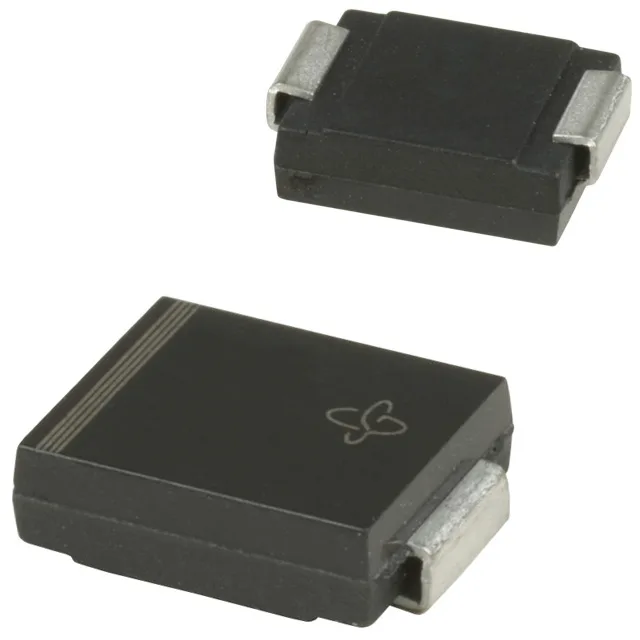
The 1.5SMC7.5CAHM3_A/H: The 6.4 V standoff is the maximum working voltage the TVS sees in normal operation — it sits across the line and leaks only microamps until a transient pushes it past the 7.13 V breakdown threshold. Once triggered, it clamps the overvoltage to 11.3 V maximum at 133 A peak pulse current, protecting whatever sensitive circuitry sits behind it. That 11.3 V ceiling, not the standoff, is what the downstream semiconductor must survive. The CA suffix marks the bidirectional polarity — one TVS element, both polarities clamped. For a 12 V automotive rail this means the same part catches both positive transients above the nominal rail and negative spikes on the return side. A unidirectional CA-unit needs no directional orientation on the board, which simplifies assembly — no polarity stripe to align, just the cathode bar on the package end.
Automotive temperature grade and AEC-Q101 context
Rated junction temperature runs to 150 °C — the upper bound for junction-limited operation during a clamping event. In practice the transient is brief; the device cools back down before the die temperature climbs that far. The -65 °C low end covers cold-soak automotive environments without the TVS triggering on a cold-start undershoot. AEC-Q101 qualification means the part has passed temperature cycling, humidity bias, and mechanical shock sequences that automotive OEMs require before approving a component for a new BOM entry. The DO-214AB SMC package is the standard large-footprint TVS body — the wide terminations on the cathode tab carry the 133 A peak pulse current away from the junction without the resistance penalty of a smaller leadframe. For rework: the SMC lands are generous, the body sits flat on the pad, and reflow profile alignment is straightforward — the part takes solder reflow like a standard SMC without special thermal management.