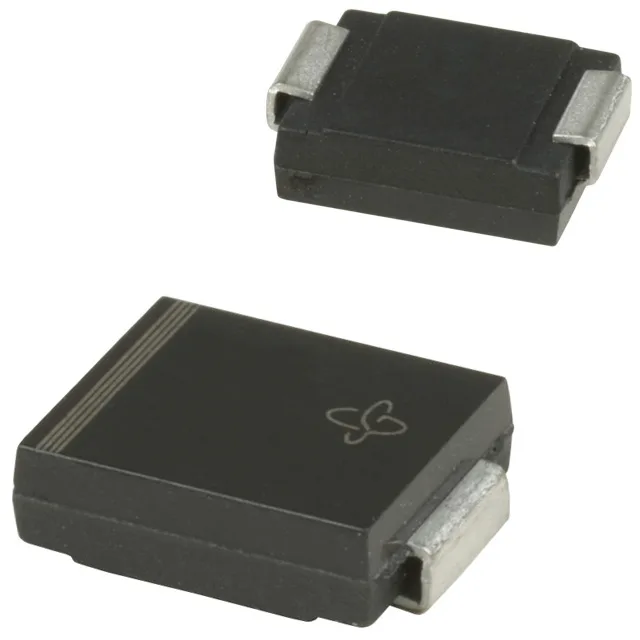
1500W bidirectional TVS for 111V rails
The 1.5SMC130CA-M3/57T: Its 111V reverse standoff voltage means it sits across a 111V DC rail without conducting leakage, then clamps transients at 179V maximum to protect downstream silicon. The 124V minimum breakdown voltage defines the point where the device starts to avalanche — below that the line sees only the diode's leakage current, which is negligible in normal operation.
Clamping current and thermal envelope
At the 179V clamp voltage the diode conducts 8.4A of peak pulse current — that is the current the bond wires and die handle during a surge event. The 1500W rating is the product of clamp voltage and peak current at the 10/1000µs waveform; a shorter pulse (8/20µs) allows higher peak current, but the datasheet's 10/1000µs figure is the standard telecom surge benchmark. Operating temperature spans -65°C to 150°C junction, covering military cold-soak and under-hood heat without derating the pulse power — though at the high end the leakage current rises and the clamp voltage shifts slightly per the temperature coefficient of the Zener.
Housed in the DO-214AB (SMC) package, the device is a surface-mount footprint compatible with standard reflow profiles. The SMC body is larger than the smaller SMA/SMB siblings, which helps spread the pulse heat into the PCB copper — a critical factor when the 1500W pulse raises the die temperature by over 100°C in under a millisecond.