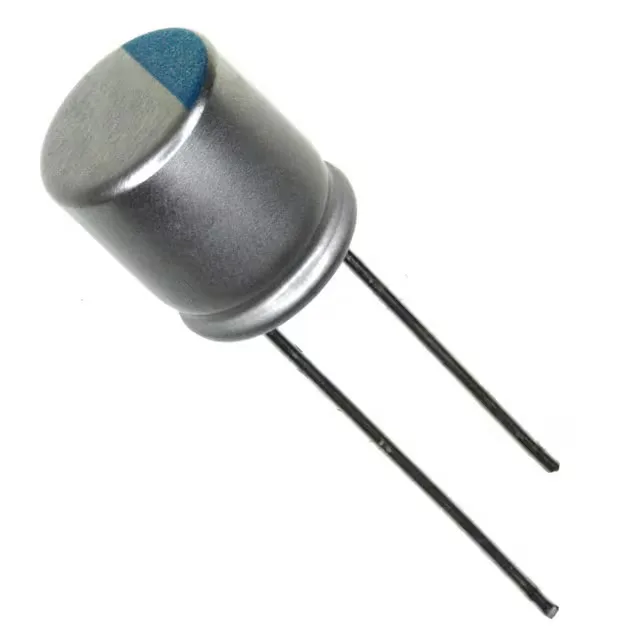
270 µF polymer — what the ripple current and ESR mean for your rail
The APSG160ELL271MF08J: The 270 µF at 16 V in the NPCAP-PSG series is a polymer (conductive-polymer) construction, which gives it a substantially lower ESR than a conventional liquid-electrolytic at the same capacitance and voltage class. The 10 mΩ ESR and the 5.08 A ripple current rating at 100 kHz mean this part handles high-frequency current transients on power rails without the impedance penalty that forces designers to parallel multiple standard capacitors. In a decoupling or bulk-storage role on a 12 V rail, a single unit does the work that would otherwise need two or three standard electrolytics.
20,000 hours at 105 °C — the endurance case for polymer
Rated life is 20,000 hours at 105 °C. That is the endurance anchor for this construction: polymer cathodes do not dry out the way liquid electrolyte does, so the lifetime spec is a real thermal-stress ceiling, not a soft guideline. A 105 °C ambient rating covers most industrial and telecom enclosure profiles without forced-air cooling, and the -55 °C cold floor handles outdoor or automotive adjacent environments without a cold-start derating concern.
Radial can, 6.30 mm dia, through-hole — PCB footprint notes
Through-hole mounting with radial leads means it sits in a board hole pattern — no surface-mount reflow profile needed, which simplifies assembly on boards already populated with through-hole regulators or connectors. Confirm the board hole diameter and spacing before committing to the BOM line, as radial can dimensions vary across series even within the same manufacturer.