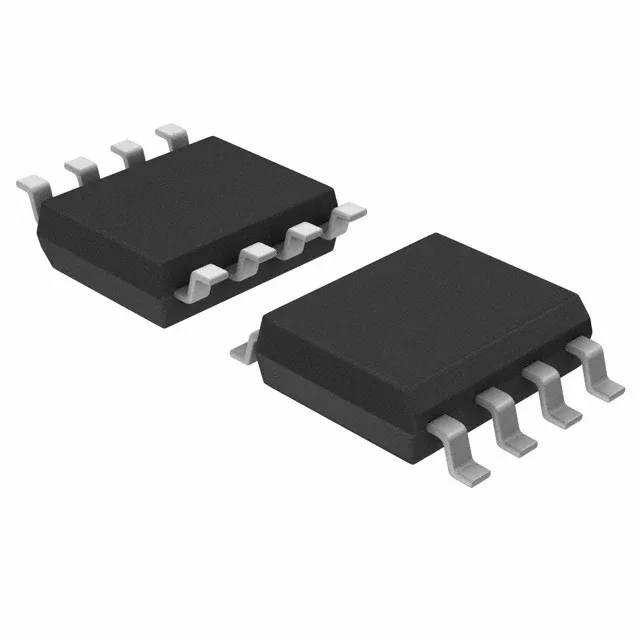
The TLC27M2CPSR: You can spec it into a new design or restock a legacy line without worrying about an imminent EOL notice.
Two CMOS channels, 285 µA total — the power budget win
This is a dual CMOS op-amp (cite:,) drawing just 285 µA for both channels combined (cite:). For a battery-powered sensor front-end or a multi-channel data-acquisition board, that quiescent current is low enough to leave headroom for the ADC and reference without a separate supply rail. The 635 kHz gain-bandwidth product (cite:) and 0.62 V/µs slew rate (cite:) cover audio-band filtering, photodiode amplification, and slow control loops — the kind of signal conditioning that doesn't need a high-speed amp but does need the power budget to stay tight.
On a bench, that means you can use high-impedance sources — a pH probe, a piezoelectric accelerometer, a 10 MΩ resistor divider — without the op-amp's own input current swamping the signal.
8-SOIC package and supply range — board-fit checklist
Operating temperature is 0°C to 70°C (cite:) — commercial grade, fine for lab equipment, benchtop instruments, and indoor industrial control. The output can source or sink 30 mA per channel (cite:), enough to drive a downstream ADC input or a small indicator LED.
ROHS3 and compliance documentation
The part is ROHS3 Compliant (cite:). Texas Instruments provides the usual compliance documentation — RoHS certificates of compliance, REACH declarations, and material composition data — through their product page and distributor portals.