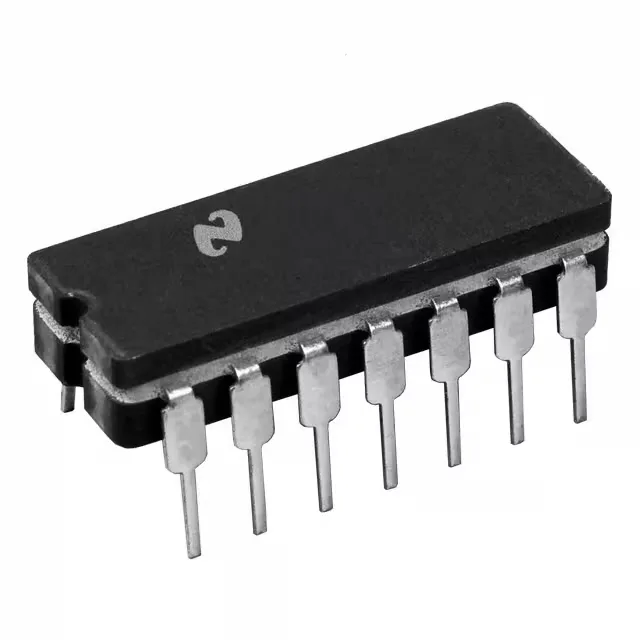
14-CDIP hermetic package — the selector for hi-rel builds
The LM224J: The hermetic ceramic cavity and through-hole mounting make this the variant you specify when the board must survive moisture, outgassing, or thermal cycling that would crack a plastic SOIC. It is not a commercial-grade plastic part — the CDIP tells you this was designed for industrial control, avionics, or long-life equipment where package reliability matters as much as the electrical spec. Four independent amplifiers in one 14-pin package, each capable of 40 mA output drive, with a supply span from 3 V to 32 V. Gain bandwidth product is 1 MHz, input offset voltage typically 2 mV, input bias current 45 nA. Supply current for all four amplifiers is 1.5 mA — useful when the power budget is tight across multiple signal-conditioning channels.
3 V to 32 V supply — single-rail or split-rail flexibility
The 3 V minimum supply lets this part run from a two-cell battery or a 3.3 V regulated rail; the 32 V maximum covers 24 V industrial buses with margin. No need to split the page into separate single-supply and dual-supply variants — the LM224J handles both. For a ±15 V system the headroom is generous; for a 5 V sensor front-end the quiescent current stays the same 1.5 mA across all four amplifiers.
Operating temperature: -25°C to 85°C
If the board sits in a conditioned indoor cabinet or a vehicle cabin, this is fine. For engine-bay or outdoor pole-mount gear that sees -40°C, you would step to the LM124 or LM224 military-grade sibling in the same CDIP footprint.
ROHS3 compliant. This is not a part you need to stockpile against an EOL — it remains in the catalog for new designs and replacement builds alike.
Date-code and marking — what to check on receipt
The 14-CDIP package carries laser-etched marking from TI. The laser etch is a fingerprint — font, depth, and position vary by assembly site and date-code week. A mismatched font or a sanded top surface is the first red flag. Lot traceability through the authorized chain is the cleanest provenance; if the part comes from broker stock, a decap and X-ray check of the die bond pads against the known LinCMOS™ layout is the only way to guarantee it is not a remarked plastic die in a scavenged ceramic package.