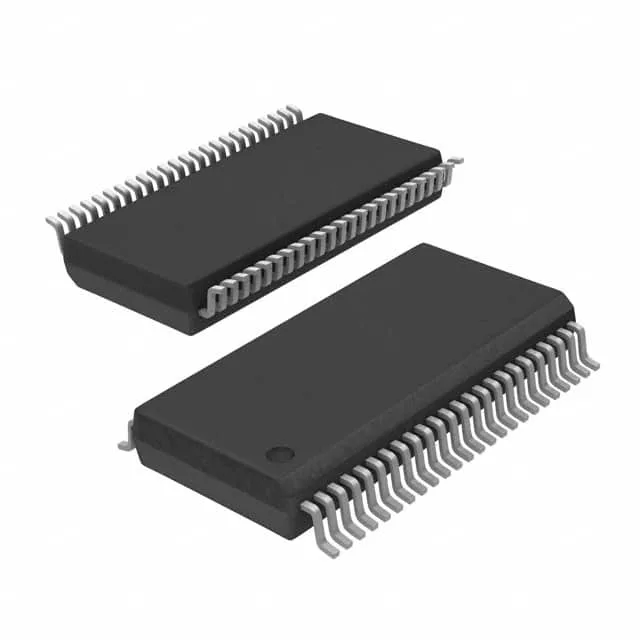
What this 16-bit bus transceiver actually is
This matters on a loaded backplane where floating inputs can draw excess supply current or cause oscillation. It's organized as two 8-bit elements with independent direction and output-enable controls, so you can use it as a single 16-bit pipe or split it for two 8-bit buses. The 3-state outputs let you isolate the bus segments when the transceiver is deselected, which is standard for shared memory or processor buses.
If your board is 3.3V-only, this isn't the part — you'd want the 74LVTH16245 variant (SN74LVTH16245ADGVR) which runs from 2.7V up. The 32mA source and 64mA sink per channel is substantial drive for a 5V bus; it can handle the capacitive loading of a multi-slot backplane or a memory array without external buffers.
Package reality: 48-SSOP on the board
The package is 48-BSSOP (0.295-inch body width, 7.50mm) — TI calls it 48-SSOP in the supplier device package field. It's a surface-mount gull-wing part, fine-pitch but hand-solderable with practice. The 7.5mm body width is wider than the 5.3mm SSOP variants, so double-check your existing footprint if you're swapping in a replacement. Cut Tape is also listed as an option, so you can order small quantities for prototyping without committing to a full reel.
Lifecycle and sourcing — no LTB clock ticking
For dual-sourcing or a drop-in replacement with a slightly lower supply floor, the SN74LVTH16245ADGVR is the closest functional second-source — same pinout, same 16-bit non-inverting transceiver function, but rated for 2.7V to 3.6V instead of 5V. If your board is strictly 5V, stick with the ABTH part.