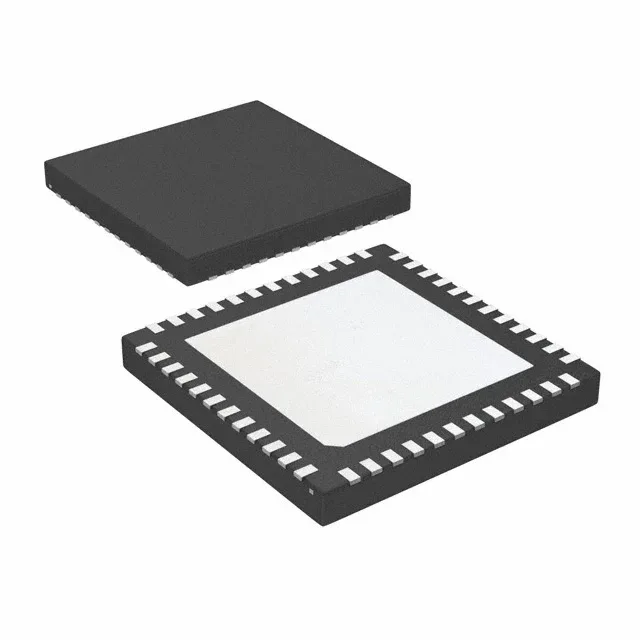
Texas Instruments LMK01020ISQE/NOPB — Clock & Timing ICs

LMK01020ISQE/NOPB Clock Buffer, 1:8 Fanout, 1.6 GHz, LVPECL

MPNLMK01020ISQE/NOPB
Active

Texas Instruments LMK01020ISQE/NOPB, Fanout Buffer (Distribution), Divider, 1:8 LVPECL outputs, 1.6 GHz max frequency, 3.15V–3.45V supply, -40°C to 85°C, 48-WQFN (7x7).

$18.4200Ref. price · indicative, final on quote
Packaging48-WFQFN Exposed Pad
RoHSROHS3 Compliant
Independent supplier — new & surplus stockAuthenticity-screened · ESD-safe packingListing updated Aug 2026

Specifications

LMK01020ISQE/NOPB specifications
ParameterValue
TypeFanout Buffer (Distribution), Divider
MountingSurface Mount
Voltage3.15V ~ 3.45V
Frequency1.6 GHz
Operating temperature-40°C~85°C
InputClock
OutputLVPECL
PackageTape & Reel (TR); Cut Tape (CT)
Case48-WFQFN Exposed Pad
Number of circuits1
Ratio - Input:Output1:8
Differential - Input:OutputYes/Yes

Product details

The Texas Instruments LMK01020ISQE/NOPB is a 1:8 fanout buffer and clock divider accepting a differential clock input and delivering LVPECL outputs up to 1.6 GHz. That 1.6 GHz ceiling is the key spec: it places this part squarely in high-speed serial-clock distribution — think ADC/DAC reference clocks, FPGA reference clocks, or SerDes PLL reference trees — where a lower-frequency buffer would limit the system's maximum data rate. The supply range is tight at 3.15 V to 3.45 V, so this is not a part you drop onto a noisy 3.3 V rail without local regulation. Plan for a dedicated LDO or a clean rail from a switching supply with post-filtering. The LVPECL outputs need proper termination — typically 50 Ω to VCC − 2 V — which adds a few resistors per output but keeps edge rates clean at 1.6 GHz.

ROHS3 compliant. For a high-speed clock tree that will stay in production for several years, this part avoids the last-time-buy scramble.

Differential input and output — layout matters

Both the single clock input and all eight LVPECL outputs are differential (Yes/Yes per). That means the input is typically AC-coupled and driven from a differential source (LVDS, LVPECL, CML). On the output side, each LVPECL pair needs 100 Ω differential impedance traces and proper termination resistors close to the receiver. The 1:8 ratio fans a single clock to eight destinations — enough for a multi-channel ADC array or a partitioned FPGA clock tree.

Frequently asked questions

Can LMK01020ISQE/NOPB be used for 1.6 GHz fanout?

Yes. The maximum frequency is 1.6 GHz, so a 1.6 GHz clock signal is within the rated operating range. At that frequency, pay close attention to the LVPECL termination and the PCB trace impedance to maintain signal integrity.

What is the output type of LMK01020ISQE/NOPB?

The output type is LVPECL, differential. Each of the eight outputs is a differential LVPECL pair requiring proper termination (typically 50 Ω to VCC − 2 V).

What are the alternatives to LMK01020ISQE/NOPB?

A close functional alternative is the CDCLVP1204RGTR from TI. It is also a LVPECL fanout buffer, but it is a 2:4 configuration (two inputs, four outputs) versus the LMK01020's 1:8. The CDCLVP1204 accepts LVCMOS, LVDS, LVPECL, and LVTTL inputs, while the LMK01020 is differential-input only. For a 1:8 fanout requirement, the LMK01020 is the direct fit; the CDCLVP1204 suits designs needing input flexibility and fewer outputs.