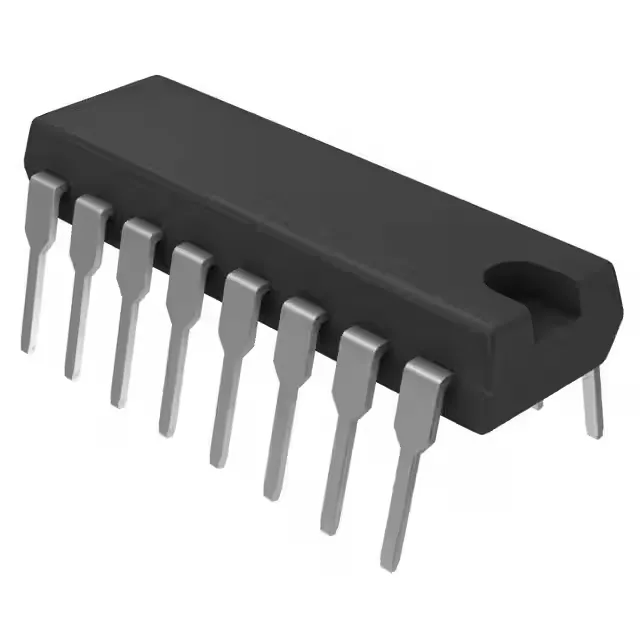
PLL with VCO and lock detect — what it does on your board
The Texas Instruments CD74HC7046AE is a 74HC-series phase-locked loop (PLL) that integrates a voltage-controlled oscillator (VCO) and a lock-detection circuit on a single chip. It accepts CMOS-level inputs and delivers CMOS-level outputs. The part is designed for clock synchronization, frequency synthesis, and FM demodulation in systems where a clean, phase-locked reference is needed — motor-drive timing, telecom framing, or data-recovery clocking in industrial control. The wide supply range of 2 V to 6 V means it can sit on a 3.3 V or 5 V rail without a separate regulator — one less BOM line.
The 38 MHz maximum frequency sets the upper bound for the VCO and phase-detector operation. If your system needs to lock to a reference above that, this part won't close the loop — you'd need a faster PLL such as the 74HCT version or a dedicated high-speed PLL. For most microcontroller clock multiplication, serial data recovery up to 38 MHz, or synthesizing a 38 MHz carrier, it has the headroom. The 1:2 input-to-output ratio means one reference input can generate two related output frequencies, useful for driving separate clock domains from a single source.
Package and mounting — through-hole for prototyping and long-life builds
Housed in a 16-pin PDIP (0.300" wide, 7.62 mm pitch) with through-hole mounting. This is the classic DIP footprint — sockets readily available, hand-solderable, and preferred for breadboard prototyping.
Lifecycle and supply — still active, no LTB clock ticking
The 74HC series has been a workhorse logic family for decades, and TI continues to support it — no need to qualify a substitute for new designs today.