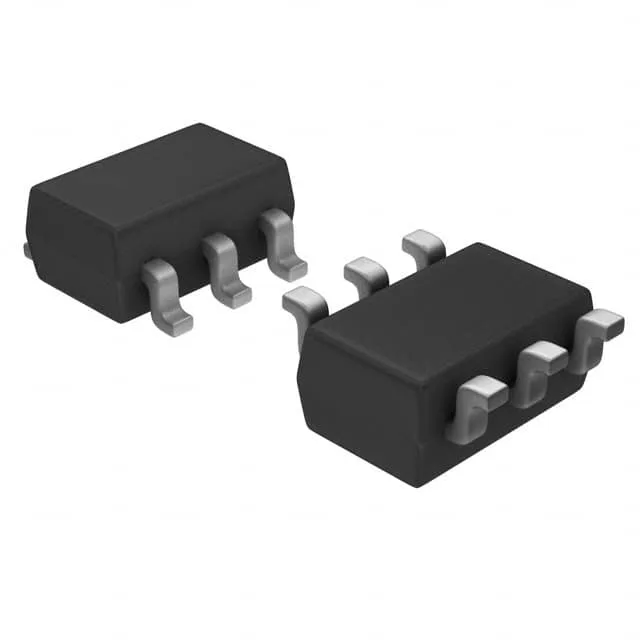
What the 350 kHz bandwidth means on a current-sense amp
The INA181A3IDBVT is a single-channel current sense amplifier from TI's INA181 family, built to measure current by amplifying the voltage across a shunt resistor. Its 350 kHz bandwidth sets the upper frequency of the current signal it can faithfully reproduce — above that, gain rolls off and the output amplitude drops. For a DC motor current or a battery charge/discharge profile, 350 kHz is plenty of headroom; for a switching regulator's inductor current waveform at a few hundred kHz, the amplifier starts to attenuate the edges, so the measured average may be accurate but the ripple shape will be blurred. The supply span runs from 2.7 V to 5.5 V, which covers the common 3.3 V and 5 V rails found on most control boards and MCU analog front-ends. The 260 µA quiescent current is low enough that the amplifier's own draw won't dominate the power budget in a multi-rail system — a battery-powered sensor node that sleeps most of the time can leave this part biased without draining the cell overnight.
Slew rate and output swing — the real limits on transient response
The 2 V/µs slew rate means the output voltage can change at a maximum of 2 volts per microsecond. If the shunt voltage jumps suddenly — say, a load step from 10 mA to 1 A — the amplifier's output will take about 1.5 µs to swing from the low end to mid-rail. That is fast enough for overcurrent detection with a typical microcontroller ADC sampling at 1 MSPS, but not fast enough to catch a sub-microsecond fault pulse. The rail-to-rail output lets the signal swing all the way to the supply rails, which is useful when the shunt voltage is small and every millivolt of dynamic range matters. Compare this to the INA254A1IPWAR, a zero-drift current sense in the same family. The INA254 runs a 350 kHz bandwidth and a similar 2.4 V/µs slew rate, but its key difference is the zero-drift architecture — it chops the input offset to keep drift under 0.1 µV/°C. The INA181A3IDBVT does not have the chopper, so its offset drifts with temperature; for a precision current measurement over a -40°C to 125°C range, the zero-drift part holds accuracy better. For a simple overcurrent flag or a battery monitor where 1-2% error is acceptable, the INA181A3IDBVT is the lower-cost choice.
Package, temperature grade, and where this part lives on a board
Housed in a SOT-23-6 package, the INA181A3IDBVT occupies about 3 mm × 3 mm of board area. The six pins break out as supply, ground, input (IN+ and IN- across the shunt), reference (REF), and output (OUT). The -40°C to 125°C operating temperature range qualifies it for industrial environments — motor drives, power supplies, and telecom equipment that see the inside of an enclosure on a hot day. The SOT-23-6 footprint is standard; any PCB layout that accommodates a generic six-pin SOT-23 will fit this part without a respin.