What the 27 MHz count rate means for your timing budget
The CD74HCT390E counts at up to 27 MHz on the clock input — this is the maximum toggle rate before the internal flip-flop propagation delay causes the output to miss edges. At 27 MHz the period is 37 ns; the counter's internal propagation delay from clock to ripple output is typically 15-20 ns at 5 V, leaving about 17 ns of setup margin for the next stage. Below 27 MHz the margin widens, but above it the counter may skip counts or produce metastable outputs. Because the counter is a ripple (asynchronous) design, the outputs do not change simultaneously — each bit toggles after the previous one settles. This ripple delay accumulates across the 4-bit BCD output, so the final output valid time is longer than a single flip-flop propagation delay. For high-speed downstream logic, a synchronous counter or an output latch after the CD74HCT390E may be needed to avoid glitches in the read window.
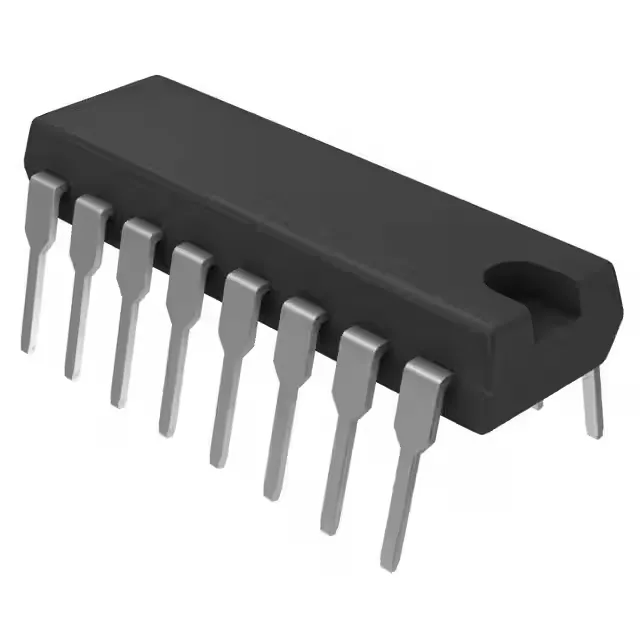
The 16-pin DIP with 0.300-inch (7.62 mm) row spacing is a through-hole package that fits standard DIP sockets or solders directly into plated through-holes. The 0.100-inch (2.54 mm) pin pitch is breadboard-friendly and easy to hand-solder or rework — no hot-air profile needed, just a soldering iron at 300-350°C. The 16-PDIP body is about 19 mm long; allow 2-3 mm clearance at each end for socket extraction. The tube packaging (: Tube) means the parts ship in anti-static tubes, not tape-and-reel. For through-hole assembly, tubes feed into standard tube feeders or are handled manually. No moisture sensitivity level (MSL) concern — DIP packages are not moisture-sensitive; no bake required before soldering.
Supply voltage and temperature grade — where this part fits
It needs a regulated 5 V supply, not a battery or unregulated bus. The 74HCT family uses TTL-compatible input thresholds (0.8 V low, 2.0 V high) and CMOS output levels, so it interfaces directly with 5 V TTL logic without level translation. At 3.3 V the part does not operate — the minimum is 4.5 V. At 125°C the propagation delay increases by about 30% over the 25°C value, so the 27 MHz count rate derates to roughly 20 MHz at the high end.
Because the part is active and widely used, supply is stable through authorized distribution. No single-source risk: the 74HCT390 function is also available from other manufacturers (Nexperia, ON Semiconductor) with the same pinout and logic function, though the Texas Instruments variant is the one on this BOM line.