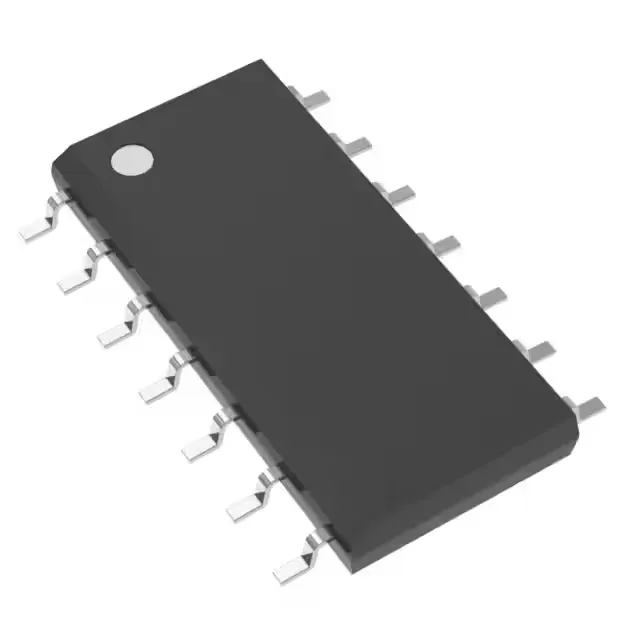
Quad 2-input NOR gate in 14-SOIC — 74HCT logic at 5V
The Texas Instruments CD74HCT02MT is a quad 2-input NOR gate from the 74HCT series, packaged in a 14-SOIC (0.154", 3.90mm Width) for surface-mount assembly. It integrates four independent NOR gates, each with two inputs, making it a compact glue-logic building block for 5V digital systems. Supply voltage spans 4.5V to 5.5V, with HCT-compatible input thresholds: logic-low at 0.8V max and logic-high at 2V min. This means it interfaces directly with 5V TTL outputs and with most 3.3V logic that meets the 2V VIH threshold — no level translator needed in mixed-voltage designs where the 3.3V driver swings above 2V. The quiescent current maxes at 2 µA, negligible for battery-backed or always-on domains.
Maximum propagation delay is 21 ns at 4.5V supply with a 50 pF load. For a 5V system clocked at 20 MHz (50 ns period), this gate consumes about 42% of the cycle — tight but workable in a single-gate path. In slower control or status-logic paths (1–10 MHz), the margin is comfortable. The delay is specified at the worst-case corner, so production units typically switch faster. Output drive is symmetric at 4 mA source and 4 mA sink, sufficient for driving one or two standard CMOS loads or a single LSTTL input. For heavier fan-out or longer traces, buffer the output or use a higher-drive family like 74AC.
Active lifecycle, ROHS3, and sourcing posture
This is a standard catalog part with stable availability through independent distribution. For dual-sourcing resilience, the 74HCT family includes multiple quad-gate variants in the same 14-SOIC footprint. The CD74HCT132M96 is a quad 2-input NAND gate with Schmitt-trigger inputs (0.5V to 0.6V low, 1.9V to 2.1V high) and a slower 33 ns propagation delay — functionally different (NAND vs NOR, Schmitt vs standard) but same supply range and package, useful if the logic function can be inverted externally.