Active production — no end-of-life watch needed
The STM8L151C6T3: RoHS3 compliance is confirmed, which means the part meets the current EU directive for hazardous-substance restrictions and can ship into regulated markets without exemption paperwork.
Core and memory — sizing the firmware budget
The STM8 core runs at 16 MHz — that is the instruction-cycle ceiling for the application. For a control loop running at 10 kHz, the CPU has roughly 1600 cycles per iteration before the scheduler overhead, which is plenty for a PID calculation and a few register writes. On-chip memory is 32 KB of Flash for program storage, 2 KB of SRAM for runtime data, and 1 KB of EEPROM for non-volatile parameters. The EEPROM is useful for calibration constants or configuration that must survive a power cycle without external storage. Program memory is Flash type, so firmware updates in the field are possible over the UART or I²C bootloader — no UV eraser or external programmer needed for reflashing.
Supply and temperature — where it lives in the system
The internal POR (power-on reset) holds the core in reset until the rail is stable, so no external reset supervisor is required for basic operation. The operating temperature span is -40°C to 125°C, which is the full industrial-plus-automotive junction-temperature range. An engine-bay ECU or an outdoor solar-powered sensor that sees 105°C on a hot day still has 20°C of margin before the silicon's thermal limit.
Peripherals and I/O — what connects without glue logic
There are 41 I/O pins brought out on the 48-LQFP package. That is enough to drive a 16×2 character LCD in 4-bit mode, read a 12-key matrix, and still have a handful of pins left for a UART debug port and a few sensor interrupts. Serial connectivity includes I²C, SPI, UART/USART, and IrDA — the usual set for talking to sensors, memory chips, radio modules, and serial displays. The IrDA interface is a bonus for wireless optical links in noisy industrial environments where a cable would pick up interference. Twenty-five analog inputs cover a lot of sensor channels — think thermistors, potentiometers, and current-sense resistors — without needing an external multiplexer. The DAC can generate an analog setpoint or a simple audio tone. On-chip peripherals include brown-out detection, a watchdog timer, PWM outputs, and a DMA controller. The brown-out reset and watchdog together provide a basic safety net for unattended equipment — if the supply dips or the firmware hangs, the MCU resets cleanly.
Package and board integration
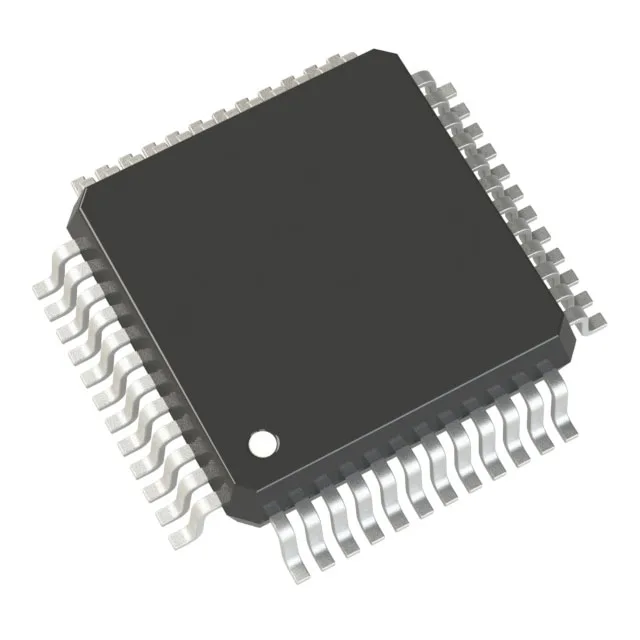
The 48-LQFP package has a 7×7 mm body with 0.5 mm pitch leads. Surface-mount assembly is standard — no special reflow profile beyond the usual lead-free solder curve. The package is supplied in a tray, which is the typical format for prototyping and low-to-medium volume production.