The 16 MHz clock is the ceiling for this STM8 core. At that speed, a tight control loop — reading a 12-bit ADC channel, running a PID calculation, updating a PWM duty cycle — completes in a few microseconds. For sensor polling at 1 kHz or simple motor commutation, the throughput is adequate. If your algorithm needs floating-point or a real-time OS tick below 62.5 µs, this part will run out of headroom; that is the decision the 16 MHz rating drives.
Memory budget: 8 KB Flash, 1 KB RAM, 256 B EEPROM
8 KB of program Flash is enough for a bootloader plus a modest application — a few state machines, a UART command parser, and a lookup table. The 1 KB SRAM limits data buffers: a single 512-byte packet uses half of it. The 256-byte EEPROM is useful for calibration constants or configuration parameters that survive a firmware update. If your firmware image exceeds 6 KB or you need more than a few hundred bytes of runtime variables, step up to a higher-density STM8L part.
Temperature grade: -40 to 125 °C
Rated for the full industrial and automotive under-hood temperature range. The 125 °C maximum junction temperature means this MCU can sit on a PCB near a motor drive, inside an engine bay enclosure, or in a downhole tool without derating.
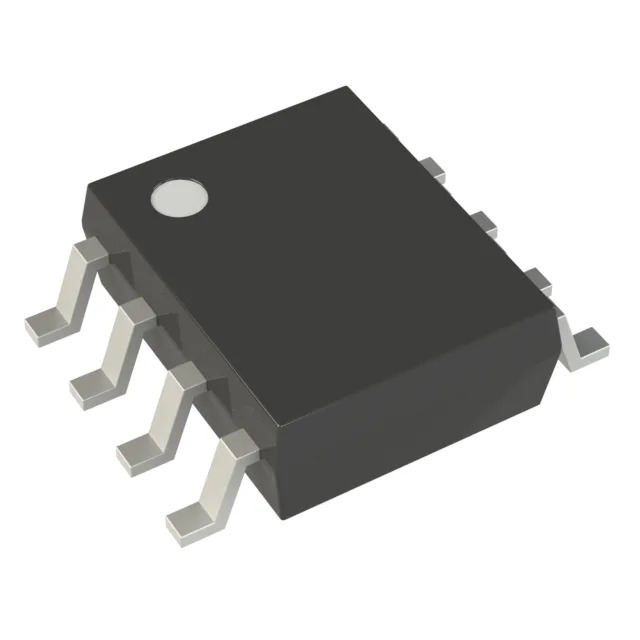
8-pin SOIC — layout and replacement angle
If a board comes in with a scorched IC in that position, the STM8L050J3M3TR is a drop-in candidate — same pad layout, same supply range. The 6 available I/O pins (plus two power pins) limit the peripheral count, but for a simple sensor interface or a PWM fan controller, that is enough.
On-chip peripherals include a 4-channel 12-bit ADC, brown-out detect, DMA, an infrared interface, LCD drive capability, PWM, and a watchdog timer.