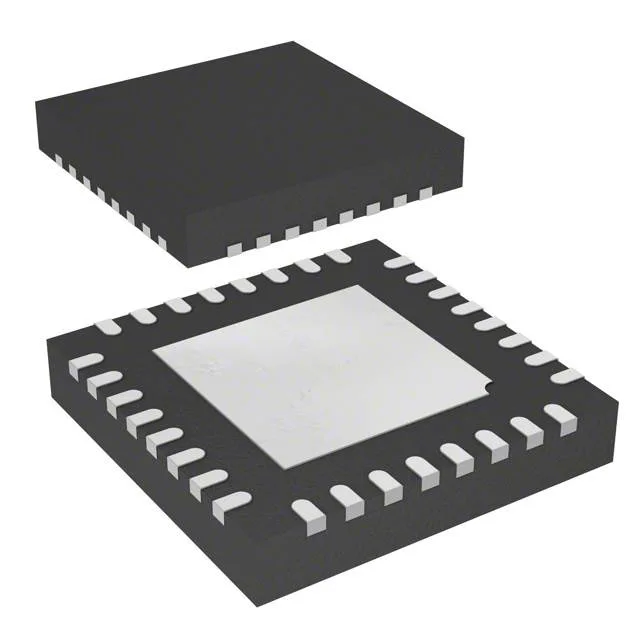
32 MHz Cortex-M0+ with 128 KB flash — memory and throughput for a compact BOM
The STM32L071KBU6 runs a 32 MHz ARM Cortex-M0+ core — the throughput ceiling for a firmware loop that polls sensors, updates a display, or manages a simple protocol stack. The 128 KB flash (128K x 8) holds a moderate application image; the 20 KB SRAM (20K x 8) leaves room for a real-time OS heap and data buffers. An additional 6 KB embedded EEPROM (6K x 8) stores calibration constants or configuration parameters without an external serial EEPROM.
Peripheral set and I/O — what connects to the 23 pins
The 32-UFQFPN (5x5 mm) package exposes 23 general-purpose I/O pins. The connectivity block includes I²C, SPI, UART/USART, and IrDA — enough for a sensor hub, a serial display, or a wireless module interface. The 10-channel 12-bit ADC (A/D 10x12b) reads analog inputs from thermistors, potentiometers, or current-sense resistors. The internal oscillator (Internal) eliminates the external crystal for many applications, saving two pins and a PCB footprint.
Active production — no end-of-life risk for this BOM line
The part is ROHS3 compliant.
How the STM32L071KBU6 compares to the STM32L151CBU6A
The STM32L151CBU6A is a higher-end sibling in the same 32-pin UFQFPN package — it swaps the Cortex-M0+ for a Cortex-M3 core, adds 14 more I/O (37 total), includes a USB interface and a dual 12-bit DAC, and keeps the same 32 MHz speed and -40°C to 85°C temperature grade. The STM32L071KBU6 is the lower-power, lower-cost entry point; the L151 is the feature-rich alternative when the application needs USB, more analog outputs, or a larger I/O count.