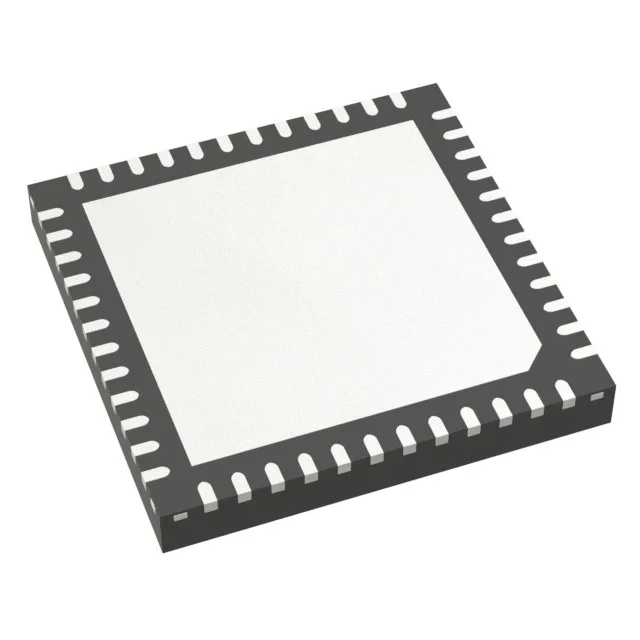
Core, memory, and the battery-life trade-off
The STM32L053C8U6 runs an ARM Cortex-M0+ core at 32 MHz — the M0+ is a two-stage pipeline design that delivers about 0.95 DMIPS/MHz, so you get roughly 30 DMIPS out of the 32 MHz clock. That is enough for a sensor hub reading an I²C accelerometer, logging to flash, and driving a segment LCD without the core waking the PLL for every interrupt. On-chip memory is 64 KB of Flash for code and constants, 8 KB of SRAM for runtime data, and a separate 2 KB of true EEPROM — not emulated — so calibration coefficients or configuration parameters survive a million write cycles without wearing the Flash.
Peripheral set for a self-contained sensor node
The part integrates a USB 2.0 full-speed device interface, a segment LCD controller that drives up to 8×40 or 4×44 segments, an I²S audio bus, and a 12-bit ADC with 10 channels plus a single 12-bit DAC. DMA is available across most peripherals, so the CPU can sleep while the ADC scans and the DMA fills a buffer. Connectivity covers I²C, SPI, two UART/USART blocks with IrDA support, and the USB peripheral — enough for a BLE module on UART, a sensor on I²C, and a debug UART without external muxing.
Supply voltage and temperature envelope
The internal oscillator is factory-trimmed to 1 % accuracy over temperature — no external crystal is required for the main clock, which saves two pins and a few mm² of board area. A 32.768 kHz crystal can still be added for RTC timekeeping.
Package and PCB layout notes
Without that, the junction-to-ambient thermal resistance rises above the 37°C/W typical figure. 37 I/O lines are brought out, including the full USB DP/DM pair, the LCD segment and common outputs, and the SWD debug port. The UFQFPN package does not have a dedicated VBAT pin for backup battery — the RTC and backup registers are powered from VDD if the main supply stays above 1.65 V.
Production status and compliance
It is ROHS3 compliant (lead-free, no exemptions). The base product number is STM32L053, so any errata or application notes for the STM32L053xx family apply. The part is available in tray packaging; the reel option is a different order code.