Core architecture and throughput ceiling
The STM32F417VGT7 runs an ARM Cortex-M4 core with single-precision FPU at 168 MHz — the DSP instruction set and floating-point unit handle FFTs, motor-control PID loops, and sensor fusion without a separate coprocessor. The 192 KB SRAM (organized as 192K x 8) provides enough working memory for dual Ethernet buffers and a real-time OS heap, though the actual headroom depends on the middleware stack and the number of active DMA channels.
Memory map and firmware budget
1 MB of on-chip Flash (1M x 8) stores the application image, bootloader, and persistent configuration tables. For a typical industrial Ethernet gateway running FreeRTOS+lwIP, the firmware footprint lands around 200-300 KB, leaving room for field-upgradeable application layers. The 192 KB SRAM splits across the main system RAM, the Ethernet descriptor buffers, and the DMA FIFOs — budget the peripheral DMA allocations before sizing the application heap.
Peripheral set for industrial connectivity
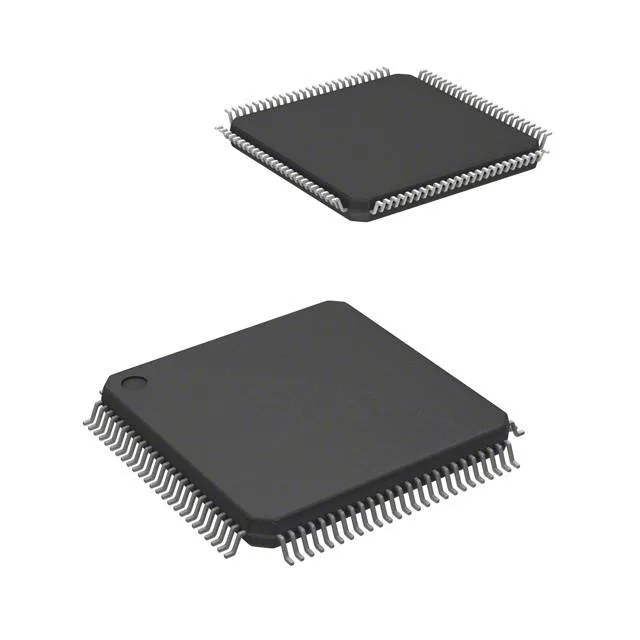
The STM32F417VGT7 integrates an Ethernet MAC (with dedicated DMA), two CAN 2.0B interfaces, USB OTG FS/HS, and a DCMI parallel camera interface. The 82 GPIOs in the 100-LQFP package leave enough pins for a parallel LCD, external memory bus (EBI/EMI), and multiple UART/SPI/I²C channels without multiplexing conflicts. Brown-out detect and the programmable watchdog keep the core safe during supply transients common in 24 V industrial panels.
The brown-out reset threshold is programmable; set it above the minimum operating voltage of the external Flash or FRAM if the board uses a separate memory device.
Analog acquisition and control outputs
The 16-channel 12-bit ADC samples at up to 2.4 MSPS in interleaved mode — enough for three-phase current sensing in a motor drive with one channel per phase plus a spare for the DC-link voltage. The dual 12-bit DAC outputs generate analog setpoints or offset correction voltages without an external SPI DAC. Both converters share the Vref+ pin; a low-drift external reference (e.g., 2.5 V or 3.0 V) improves the ADC absolute accuracy over the internal bandgap.
Lifecycle and compliance status
The part is ROHS3 compliant. For new designs, the active status means no immediate migration pressure; the STM32F4 series has a long tail of production support.