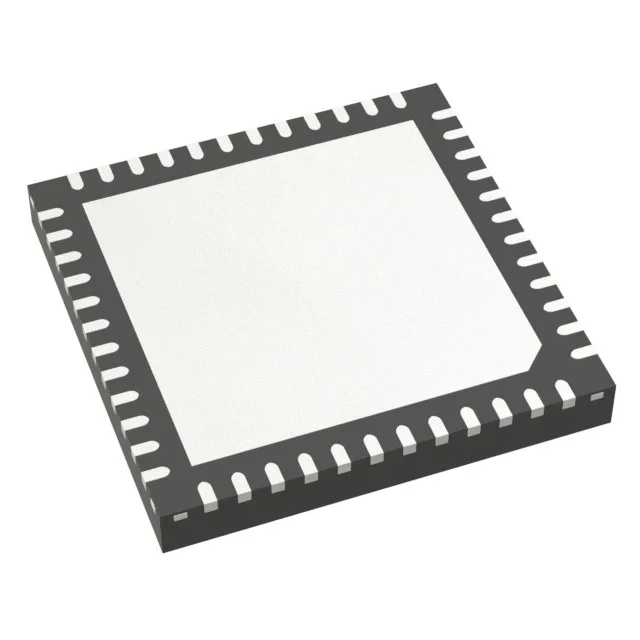
The 48-pin UFQFPN package with exposed pad keeps the footprint compact at 7x7 mm while offering 36 general-purpose I/O lines. On the peripheral side, the part includes USB OTG for direct host/peripheral switching, SDIO for external storage, three SPI and three I²C interfaces, plus a 10-channel 12-bit ADC.
84 MHz Cortex-M4 — where the speed matters
The FPU accelerates sensor fusion and PID calculations without software emulation. For a motor-drive or digital-power design, the 84 MHz clock gives enough headroom to run a 20 kHz current loop with a few hundred microseconds left for communications and housekeeping.
256 KB of Flash supports a moderate application: a FreeRTOS kernel, a USB stack, a CANopen or Modbus library, and a few thousand lines of application code fit without squeezing. 64 KB of SRAM is the tighter resource — it limits buffering for USB mass-storage class or large audio buffers. If your application needs a 50 KB heap for JSON parsing or a 20 KB double-buffer for a camera sensor, the 64 KB ceiling forces careful allocation or an external SRAM.
Industrial temperature and package — design-in notes
The 7x7 mm body is hand-solderable with a hot-air station, but the fine 0.5 mm pitch calls for a good stencil and reflow profile — MSL 3 handling applies (bake before reflow if the moisture-barrier bag has been open beyond the floor-life window).
ST continues to manufacture the STM32F4 series, and this density/package variant remains in the current portfolio.