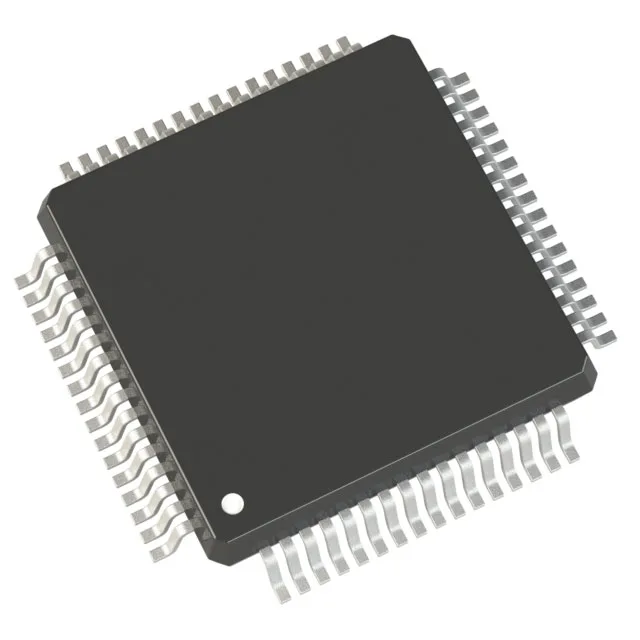
STMicroelectronics STM32F410RBT6 — Microcontrollers & Processors (MCU / MPU / DSP)

STM32F410RBT6 STM32F4 MCU, 100 MHz, 128 KB Flash, 64-LQFP

MPNSTM32F410RBT6
Active

STMicroelectronics STM32F4 series ARM Cortex-M4 32-bit MCU, 100 MHz, 128 KB flash, 32 KB SRAM, 50 I/O, 64-LQFP (10x10 mm), -40 to 85 °C, Tray.

$5.4300Ref. price · indicative, final on quote
Packaging64-LQFP
RoHSROHS3 Compliant
SeriesSTM32F4
Independent supplier — new & surplus stockAuthenticity-screened · ESD-safe packingListing updated Aug 2026

Specifications

STM32F410RBT6 specifications
ParameterValue
SeriesSTM32F4
MountingSurface Mount
Oscillator typeInternal
Program memory typeFLASH
Voltage - supply (Vcc (Vdd))1.7V ~ 3.6V
Operating temperature-40°C ~ 85°C (TA)
Speed100MHz
PackageTray
RAM size32K x 8
Core size32-Bit Single-Core
PeripheralsBrown-out Detect/Reset, DMA, I²S, POR, PWM, WDT
ConnectivityI²C, IrDA, LINbus, SPI, UART/USART
Number of i (O)50
Core processorARM® Cortex®-M4
Case64-LQFP
Data convertersA/D 16x12b; D/A 1x12b
Program memory size128KB (128K x 8)

Product details

100 MHz Cortex-M4 with 128 KB flash — the BOM-fit anchor

The STM32F410RBT6: That core includes a single-precision FPU and DSP instructions — the architectural edge over an M3 for FIR filters, FFTs, or control loops that need hardware float support without a software emulation tax. On-chip memory: 128 KB flash and 32 KB SRAM. The flash holds the application binary and bootloader; the SRAM split between stack, heap, and DMA buffers. For a typical sensor-fusion or motor-control firmware with a HAL and RTOS footprint, budget roughly 20–30 KB for the kernel and middleware — the remaining flash is the application payload. 50 general-purpose I/O in a 64-LQFP package (10×10 mm, 0.5 mm pitch). That pin count serves most control-panel and instrumentation designs without forcing a larger package, but the 0.5 mm pitch demands a 4-layer PCB for reliable fan-out of the inner rows. The 64-LQFP is a hand-solderable footprint for prototyping; production reflow follows standard JEDEC MSL profiles.

Supply, temperature, and analog chain

No external supervisor needed for most single-rail designs. This covers factory-floor enclosures, outdoor telecom cabinets, and engine-bay-adjacent electronics where the PCB sees 70–80 °C steady-state. The internal oscillator trims across the full range — no external crystal required for UART or SPI timing, though the HSE input is available if the application needs tighter accuracy for USB or CAN. The ADC scans up to 16 single-ended inputs with programmable sampling time — useful for reading thermistors, potentiometers, or current-sense resistors. The DAC outputs a single analog voltage for set-point or bias generation. The I²S interface pairs with external codecs for audio or voice-band processing.

Frequently asked questions

What is the closest functional second-source to the STM32F410RBT6?

The STM32L151CBU6A is a Cortex-M3 alternative at 32 MHz with the same 128 KB flash and 32 KB SRAM, but it uses a different core (M3 vs M4 with FPU), fewer I/O (37 vs 50), a smaller package (48-UFQFPN vs 64-LQFP), and a different supply voltage range. It is not a pin-compatible or drop-in replacement — a board redesign and firmware migration are required.

What is the maximum clock speed of the STM32F410RBT6?

The STM32F410RBT6 runs at 100 MHz on its ARM Cortex-M4 core with FPU and DSP instructions. The flash wait states at this speed are typically 4 cycles; the prefetch buffer and instruction cache reduce the effective penalty for sequential code.