72 MHz Cortex-M4 with 16 KB flash — what fits in the firmware budget
The STM32F334C4T6 runs an ARM Cortex-M4 core at 72 MHz — the 225 DMIPS ceiling is set by the flash wait-state profile at that clock, not the core itself. 16 KB of on-chip flash and 12 KB of SRAM mean the application code and interrupt vector table share a tight footprint; a bootloader, HAL, and a moderate control loop leave roughly 4–6 KB for application logic before the linker overflows. The 15-channel 12-bit ADC and 3-channel 12-bit DAC let this part handle mixed-signal loops — current sensing, voltage monitoring, and analog output — without an external converter. The DMA controller offloads ADC result transfers directly to RAM, keeping the core free for the control algorithm.
48-LQFP board-fit: pitch, fan-out, and thermal
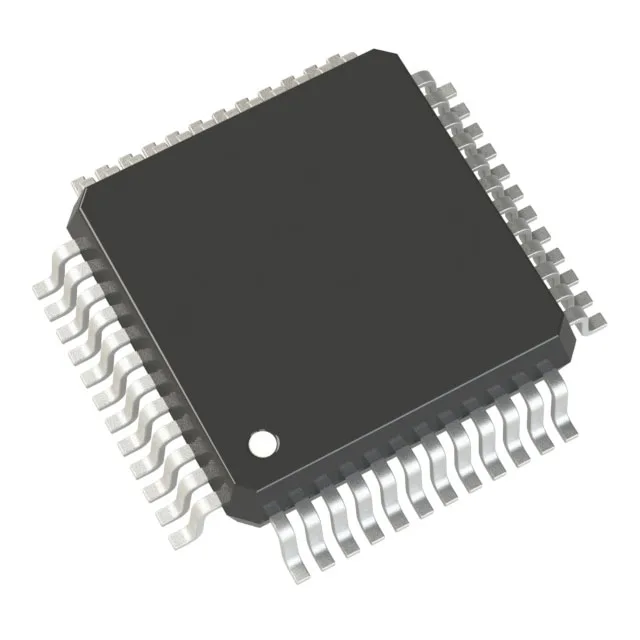
The 48-LQFP package measures 7x7 mm with 0.5 mm pitch. A two-layer PCB can fan out the inner rows of the 37 I/O lines, though the CANbus and analog channels benefit from a ground plane underneath. The exposed pad is not present on this package — heat dissipates through the leads, so the ambient temperature ceiling of 85°C is the practical limit without forced airflow.
Connectivity and peripheral mix for industrial control
The CAN controller supports the basic frame format used in most industrial automation nodes. LINbus and IrDA are also on the peripheral list, though the IrDA physical layer needs an external transceiver. The PWM timer channels can generate complementary outputs with dead-time insertion — useful for half-bridge and full-bridge motor drives. The POR and watchdog peripherals are standard for unsupervised startup in a remote sensor node.
ROHS3 compliant per.