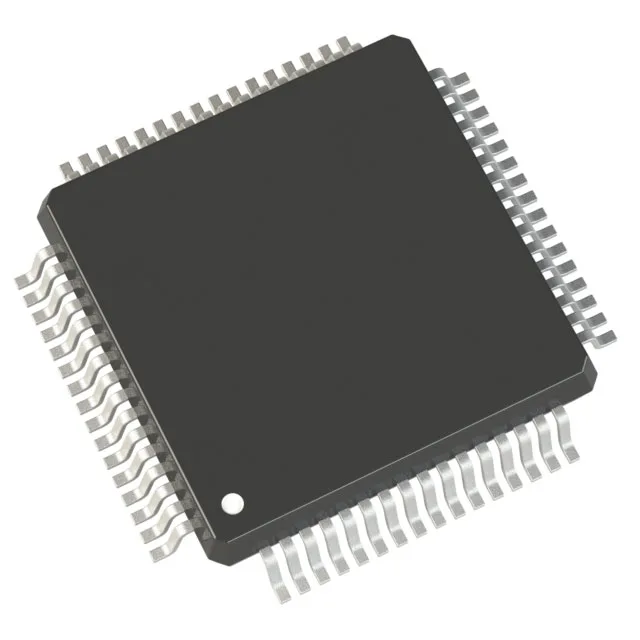
72 MHz Cortex-M4 with FPU — real-time signal chain
The STM32F302R8T6 is an STM32F3-series ARM Cortex-M4 microcontroller clocked at 72 MHz, with a single-cycle multiply-accumulate and hardware FPU. That clock ceiling and the DSP instruction set make it a fit for mixed-signal control loops — motor current sensing, digital power conversion, or sensor fusion — where the math must finish inside a PWM cycle without an external co-processor. On-chip memory is 64 KB Flash and 16 KB SRAM (16K x 8). For a field-oriented motor control firmware with a 10 kHz current loop, the 64 KB code space holds the vector math tables and the 16 KB RAM buffers the ADC samples and the state machine. The 51 GPIOs in the 64-LQFP package leave enough pins for parallel encoder inputs and a display interface without a port expander.
15-channel ADC, DAC, and connectivity set
Fifteen 12-bit ADC channels and one 12-bit DAC are integrated on-chip. In a three-phase motor drive, the 15 ADC inputs cover the three phase currents, the DC-link voltage, and the temperature sensors — no external multiplexer needed. The DAC can generate the analog reference or the offset trim for the downstream signal chain. The CAN interface connects to industrial fieldbus backbones; the USB peripheral handles direct PC logging or firmware updates. The 72 MHz clock comes from an internal oscillator — no external crystal required for the core timing, though the USB and CAN blocks still need a precision source for the bit timing.
Active lifecycle, ROHS3, and sourcing posture
The base product number is STM32F302; the 'R8' suffix indicates 64 KB Flash in the 64-LQFP package. The 64-LQFP (10x10 mm) footprint is a standard 0.5 mm-pitch quad flat pack — a 4-layer board with a ground plane under the exposed pad handles the thermal dissipation for the 72 MHz core.