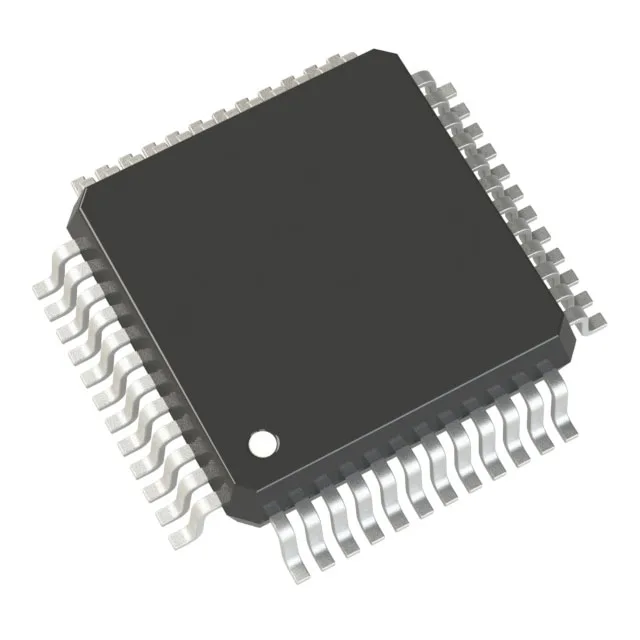
48 MHz Cortex-M0 with 256 KB flash — where the memory budget lands
The STM32F091CCT6 is an STM32F0-series microcontroller built around the ARM Cortex-M0 core running at 48 MHz. That clock ceiling and the 256 KB of on-chip flash (256K x 8) define the application envelope: firmware for a motor controller, a CAN-bus sensor node, or a multi-protocol field-device gateway fits comfortably, but a graphics-heavy HMI or a real-time audio stream will bump into the memory wall. The 32 KB SRAM (32K x 8) leaves room for a moderate stack and a few ring buffers — enough for a Modbus RTU slave with a dozen holding registers, but tight if you are double-buffering ADC samples at 1 MSPS.
Peripheral mix — what the 38 I/O pins actually connect to
With 38 I/O lines in a 48-LQFP package, the STM32F091CCT6 gives you enough headroom for a typical sensor-to-cloud edge node: a CAN transceiver, an I²C temperature sensor, an SPI flash for data logging, and a UART for the debug console. The 13-channel 12-bit ADC (A/D 13x12b) and the dual 12-bit DAC (D/A 2x12b) cover analog front-end duties without an external converter — the ADC can sample three-phase current feedback on a motor drive while the DAC generates a setpoint voltage. The peripheral set includes DMA, I²S, POR, PWM, and WDT — the DMA engine offloads the Cortex-M0 during high-speed SPI transfers, and the PWM timers can generate complementary outputs for a half-bridge gate driver. The internal oscillator means you can skip an external crystal for non-critical timing, though the CAN and I²C peripherals still benefit from a precision clock source if the bus timing needs tight tolerance.
Supply voltage and temperature — the industrial deployment envelope
That means it lives on a factory-floor PCB without a heater or a fan, but it does not qualify for under-hood automotive (125°C) or avionics (125°C+). The 48-LQFP package (7x7 mm) is hand-solderable for rework and fits a two-layer board with reasonable fan-out. The part ships in a tray, which is the standard delivery format for volume pick-and-place. RoHS3 compliant (ROHS3 Compliant).