Active production — no end-of-life horizon on this BOM line
The STM32F030R8T6TR: ROHS3 compliance is confirmed, clearing EU and global regulatory acceptance without a waiver or exemption expiry to track.
48 MHz Cortex-M0 — throughput ceiling for control-loop and sensor-fusion tasks
The ARM Cortex-M0 core runs at 48 MHz, delivering approximately 48 DMIPS from the single-cycle multiplier and the two-stage pipeline. For a motor-control loop sampling at 10 kHz, the available instruction budget per cycle is roughly 4,800 instructions — enough for a PI regulator, commutation table lookup, and overcurrent check without saturating the core.
64 KB Flash, 8 KB SRAM — firmware budget for moderate-complexity applications
Program memory is 64 KB of Flash (64K x 8), with 8 KB of SRAM (8K x 8). A typical HAL plus RTOS footprint (FreeRTOS + STM32Cube HAL) consumes roughly 12-16 KB of Flash and 2-3 KB of RAM, leaving 48-52 KB for application code and 5-6 KB for runtime data. This suits sensor-fusion algorithms, Modbus stacks, or simple HMI logic without external memory. The Flash is organized as 1 KB pages with 20 ms typical erase time per page — firmware-over-the-air updates are feasible if the bootloader manages page-by-page erase and write within the available RAM buffer.
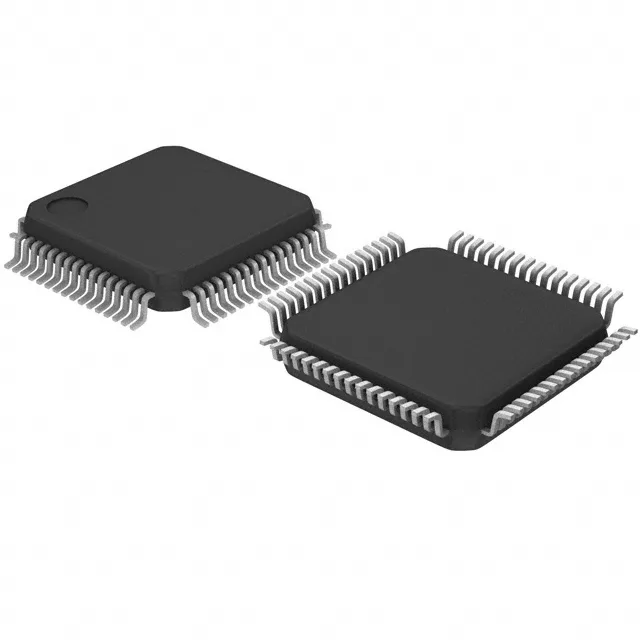
64-LQFP (10x10 mm) — board-area footprint and fan-out constraints
A two-layer board can fan out the inner rows if the trace width is kept to 0.18 mm and via-in-pad is avoided; a four-layer stack-up is recommended when all 55 GPIOs are used simultaneously to keep the return-path inductance low. The exposed pad (ePad) on the bottom of the package is electrically connected to VSS.
Industrial temp range -40 to 85°C — deployment envelope for factory-floor and outdoor equipment
This qualifies the part for factory automation panels, outdoor sensor nodes, and engine-bay-adjacent electronics that see ambient temperatures up to 70°C with self-heating margin.
55 GPIOs, 18-channel 12-bit ADC — I/O and analog front-end capacity
55 general-purpose I/O pins are available, with most mapped to alternate functions for the serial peripherals (I²C, SPI, UART/USART). The 18-channel 12-bit ADC samples at up to 1 Msps — sufficient for reading 18 thermocouple inputs at 50 Hz each, or 6 current-sense resistors at 300 kHz per channel. On-chip peripherals include DMA (for ADC result transfer without CPU intervention), POR (brown-out reset at 2.0 V typical), PWM timers (up to 16-bit resolution), and a watchdog timer. These reduce the external component count for a basic control board to just the MCU, a decoupling capacitor, and the programming header.
Sourcing posture — active, quoted to order
The tape-and-reel packaging (TR) is the standard shipping format for automated pick-and-place assembly. Cut-tape (CT) quantities are also available for prototyping or low-volume builds.