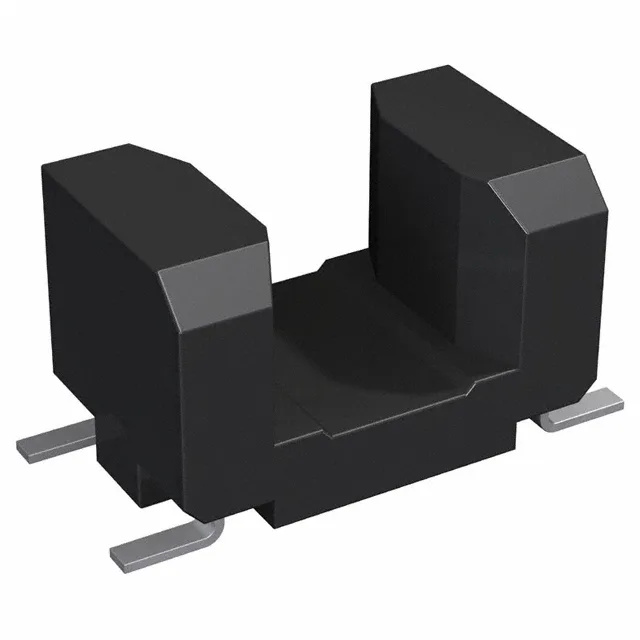
0.079 mm gap, transistor output — what it means on the board
The RPI-0226 is an unamplified slot-type optical sensor with a transistor output, housed in a surface-mount package from ROHM Semiconductor. The 0.079 mm sensing gap is tight — it detects the presence of an opaque flag or encoder disk that interrupts the beam, not general proximity. The transistor output switches up to 50 mA at 30 V, so it drives a logic input or a small relay directly without a buffer stage.
Ratings that govern the fit
Supply voltage is rated 30 V maximum — the transistor output can handle 30 V open-collector, but the internal LED and phototransistor are biased from the same rail, so the actual operating voltage should stay within the 5-24 V range typical for slot sensors. The 50 mA switching current is the collector current limit; if the downstream load draws more, the transistor saturates and the output voltage rises above the logic-low threshold. Response time is 50 µs — fast enough for counting parts on a conveyor at moderate line speeds or sensing a rotating shaft slot at a few thousand RPM. The 0.079 mm gap means the flag or vane must be thin and precisely aligned; a thicker vane that does not fully clear the gap leaves the beam partially blocked and the output indeterminate. Operating temperature range is -30°C to 85°C — this covers most indoor industrial and commercial environments but not extended automotive under-hood or outdoor direct-sun exposure. The surface-mount package reflows with standard lead-free profiles; the tape-and-reel packaging suits automated pick-and-place.