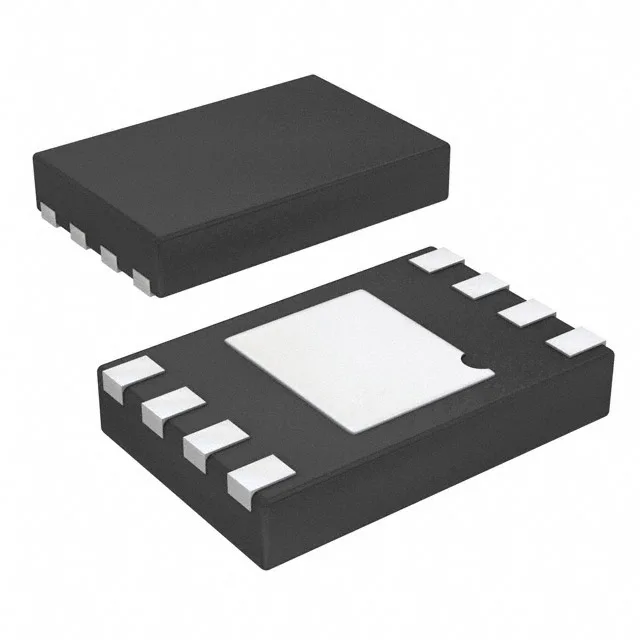
Triple 200 mA LDO for multi-rail sensor and analog supplies
The BU6655NUX-TR: That combination — three outputs, three distinct voltages, one small footprint — targets boards that need a clean analog supply (the 3.3 V), a sensor bias rail (the 2.8 V), and a logic or I/O voltage (the 1.8 V) without dedicating separate regulators to each.
PSRR and quiescent current — what they mean for the rail
The PSRR is listed at 70 dB at 1 kHz, dropping to 65 dB at the same frequency in the other entries — the 70 dB figure is the one to budget for. At 70 dB, a 100 mVpp ripple on the input rail is attenuated to roughly 32 µVpp on the output. That matters when this LDO feeds an analog front-end or a small-signal chain where the supply noise would otherwise fold into the signal band. Quiescent current is 95 µA typical. For an always-on domain — say a sensor that wakes on an interrupt — the 95 µA draw plus the load current sets the battery drain. The 285 µA maximum supply current gives the worst-case overhead if all three outputs are loaded near their limits.
Dropout and protection — the real-world margins
Dropout voltage is specified as 0.72 V at 200 mA on one output and 0.46 V at 150 mA on another. The headroom between the input rail and each output must stay above these figures across the load range to keep the output in regulation. With a 5 V input feeding the 3.3 V rail, the margin is 1.7 V — plenty. But if the input dips toward 4.0 V, the 1.8 V rail still has 2.2 V headroom while the 3.3 V rail has only 0.7 V, which is tight against the 0.72 V dropout at full load. Over-current and over-temperature protection are built in — the part shuts down before the junction exceeds the die rating or the output current climbs past the safe limit. The enable pin lets a system processor gate the rails in a power-up sequence.
The thermal resistance depends on the board layout — the datasheet's RthJA figure assumes a standard JEDEC board with a certain copper area. For a triple LDO dissipating up to about 1.2 W (600 mA total at 2 V dropout), the exposed pad needs a solid via array to the inner ground plane. The 5.5 V input maximum means this part runs from 3.3 V, 5 V, or a lithium-ion battery directly — no pre-regulation needed.