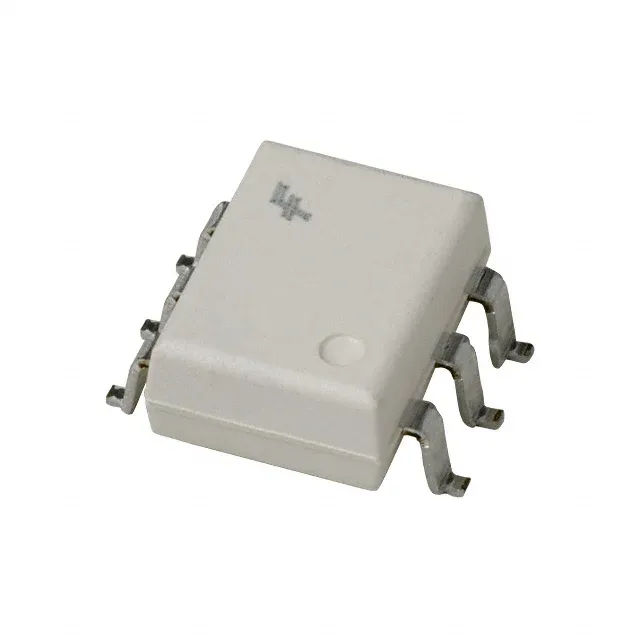
Isolation barrier and signal transfer
The 4N35SR2VM provides 4170Vrms galvanic isolation between input and output — this is the one-minute hipot test voltage per UL 1577, not a working voltage. For a 250Vrms mains-referenced circuit, the reinforced isolation margin holds comfortably, but the working voltage rating should be confirmed against the application's continuous line-to-ground voltage. Minimum current transfer ratio of 100% at 10mA forward current means the output transistor saturates with collector current equal to the input drive — no gain margin to waste on a weakly driven LED. The typical 1.18V forward drop at that current sets the input-side power budget. Turn-on and turn-off times are 2µs typical each — this is a phototransistor, not a logic-output coupler. The 2µs delay limits the usable data rate to roughly 250 kbps in a non-return-to-zero scheme; faster edges require a base-emitter resistor to sweep stored charge, which the internal base access pin allows.
Surface-mount 6-SMD gull wing package — the 4N35SR2VM variant ships on tape and reel or cut tape, suited for pick-and-place assembly. The 6-SMD footprint matches the standard DIP-6 through-hole pattern shifted to surface-mount pads; the gull-wing leads require a solder paste stencil aperture sized for the lead foot, not the body. Operating temperature range from -40°C to 100°C covers industrial enclosures and outdoor cabinets — the phototransistor's current gain drifts with temperature, so the 100% CTR minimum at 25°C should be derated by roughly 0.5%/°C above 25°C for the worst-case collector current at the high end.
Base product number 4N35 indicates this is a standard phototransistor optocoupler in the 4N35 family, widely second-sourced across manufacturers. The SR2VM suffix denotes onsemi's specific surface-mount gull-wing package and tape-and-reel packing option.