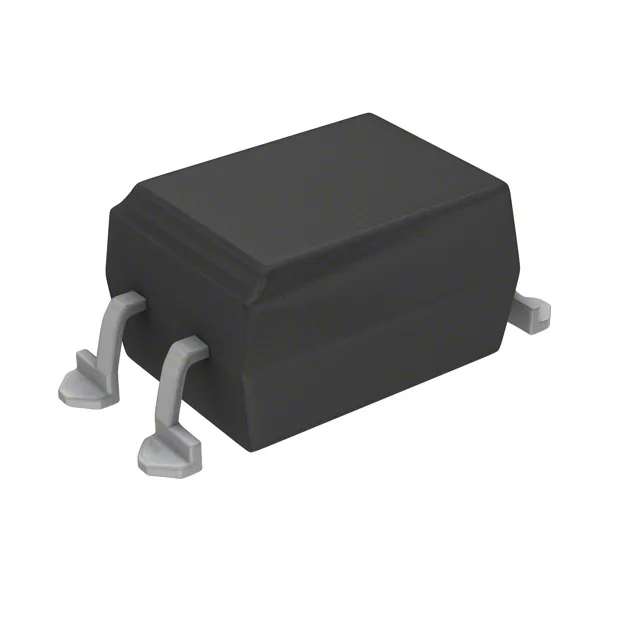
What this opto does in the assembly
The Vishay SFH618A-5X007T is a single-channel DC-input phototransistor optoisolator in a 4-SMD gull wing package. It provides 5300Vrms galvanic isolation between the input LED and output phototransistor, with a current transfer ratio between 250% and 500% at a forward current of 1mA. The output transistor can handle up to 55V and 50mA, with a maximum Vce saturation of 400mV.
5300Vrms isolation — what it buys you
The 5300Vrms isolation rating is the headline safety spec. For a PCB layout engineer, that number drives the creepage and clearance distances under IEC 60950 or IEC 62368 — you need at least 8mm creepage between primary and secondary for reinforced insulation at 250V working voltage. The 4-SMD gull wing package gives you the surface-mount footprint with enough pin spacing to meet that. For the component engineer, this is a reinforced-isolation-class device suitable for mains-isolated circuits, not just basic insulation.
CTR spread and the 1mA test point
The 250% to 500% CTR range is specified at 1mA forward current, not the usual 5mA or 10mA. That means this opto is designed to work with low-drive logic outputs — a 3.3V GPIO with a 2.2k series resistor delivers about 1.5mA, well within the 60mA absolute max forward current. The wide CTR spread means the test engineer needs to verify the minimum CTR at the operating temperature, because the phototransistor gain drops as the junction warms up. At -55°C the CTR will be at the high end; at 100°C it'll be at the low end. Plan your pull-up resistor value around the minimum CTR at the worst-case temperature.
Switching speed — slow but predictable
Rise time is 3.5µs typical, fall time 5µs typical, turn-on 6µs, turn-off 5.5µs. For the firmware engineer, budget at least 10µs of propagation delay in any feedback loop that goes through this opto. It works fine for 100kHz PWM signals, DC state sensing, or relay-coil drive. If you need faster, look at the logic-output or high-speed opto families; this one is for the slow-and-reliable jobs where isolation integrity matters more than bandwidth.
Temperature range and field service
If your assembly sits near a hot power stage or inside a sealed enclosure that can hit 105°C, this part is outside its rated range. For the field-service technician: this is a surface-mount part with gull-wing leads, so it can be swapped on site with a hot-air station and some solder wick. The package marking should be legible under magnification, but the 4-SMD body is small — bring a headset magnifier.
It is ROHS3 compliant.