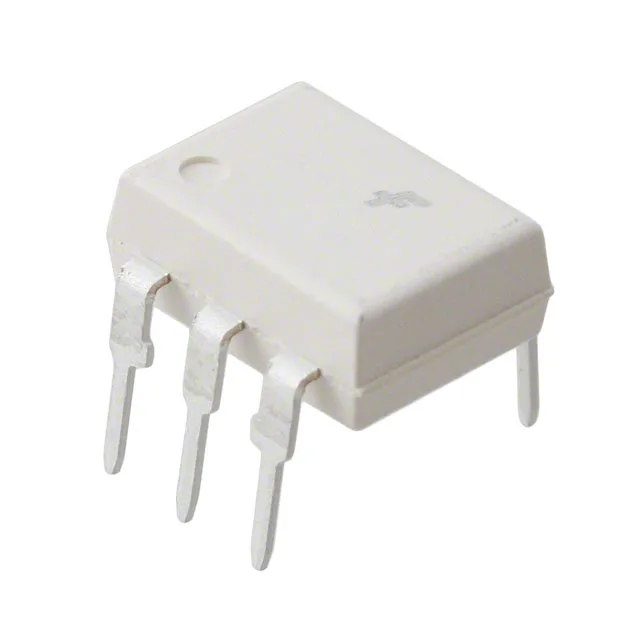
Isolation and signal transfer in a 6-DIP footprint
The onsemi CNY174M is a single-channel optoisolator that bridges a DC input LED to a phototransistor output with base access, all in a standard 6-DIP through-hole package. Its 4170Vrms isolation rating meets the reinforced insulation requirements for separating low-voltage control circuits from higher-voltage power stages or field wiring.
CTR and switching speed — what they mean for the BOM
The current transfer ratio spans 160% minimum to 320% maximum at a 10mA forward current — this is the gain margin you budget for LED degradation over temperature and lifetime. A CTR of 160% means the output transistor can sink at least 16mA when the LED is driven at 10mA, which is enough to pull a standard 5V logic input low through a 330-ohm pull-up. Switching is not fast: typical turn-on is 2µs, turn-off 3µs, with rise and fall times of 4µs and 3.5µs respectively. This limits the part to DC-level or low-frequency signal isolation — think status feedback, relay coil drives, or 50/60Hz zero-cross detection. At data rates above about 100 kbps the pulse-width distortion becomes unacceptable. The output transistor is rated for 70V collector-emitter and 50mA continuous current — enough to drive a small relay or a PLC input module directly without a buffer transistor.
Active lifecycle and industrial temperature range
The base terminal on the output side allows the designer to bias the phototransistor for faster turn-off or to configure a Darlington pair for higher current gain, though the base is often left open in simple switch applications.
Package, mounting, and supply format
Supplied in tube format, the 6-DIP (0.300-inch, 7.62mm pitch) through-hole package is a legacy footprint that remains common in industrial control boards where wave-solder assembly is the standard. The 7.62mm row spacing matches the standard DIP socket or plated-through-hole layout — no board redesign needed if replacing an older 6-DIP opto.