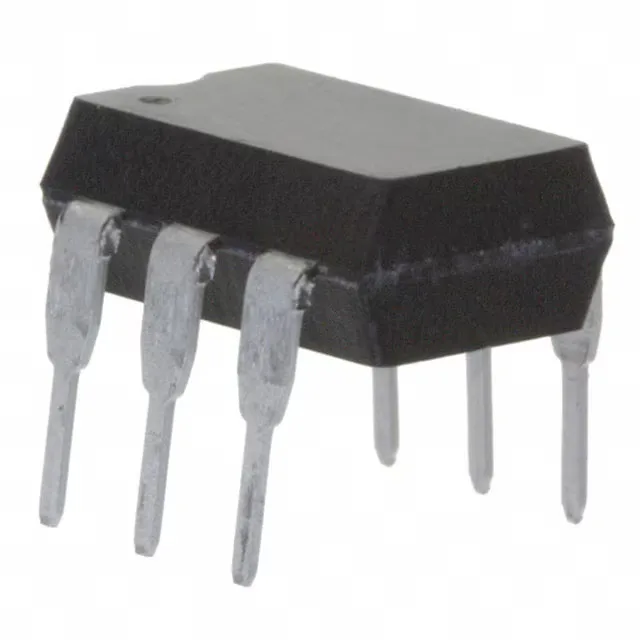
5300Vrms isolation — where this optocoupler fits the BOM
That isolation rating puts it squarely in industrial power supplies, motor-drive feedback paths, and PLC I/O modules where galvanic separation is required for safety and noise immunity.
The current transfer ratio is specified as 50% minimum and 80% maximum at a forward current of 10 mA. That means with 10 mA through the LED, the output transistor can sink between 5 mA and 8 mA. For a design driving a 5 V logic input with a 10 kΩ pull-up, the 0.5 mA load is well within the CTR floor, so the LED drive can be reduced to save power. If the load is a 24 V industrial input with a 2.2 kΩ resistor (about 11 mA), the 50% CTR minimum still guarantees saturation — but the 400 mV Vce(sat) ceiling means the output voltage drop stays under 0.4 V at that current, keeping the logic-low threshold clean.
Switching speed: 2 µs rise/fall, 3 µs turn-on
Rise and fall times are both 2 µs typical; turn-on time is 3 µs and turn-off is 2.3 µs. That limits this part to applications below about 100 kHz switching frequency — fine for 50/60 Hz line-sync isolation, DC bus voltage sensing, or relay-coil feedback, but not for high-speed data isolation. The transistor output lacks a base-access pin for speed-up networks, so the 2 µs edges are the practical ceiling.
Package and mounting: 6-SMD gull wing, surface-mount only
Supplied in a 6-pin SMD gull-wing package (6-SMD), this is a surface-mount-only part. The gull-wing leads are suitable for standard reflow soldering. Cut Tape is fine for prototypes and small runs. Store the reels dry: optocouplers are moisture-sensitive, and the MSL rating (not stated in this listing) should be checked on the reel label before reflow.
The 100°C ceiling is the junction temperature — derate the output current if the ambient runs above 85°C.