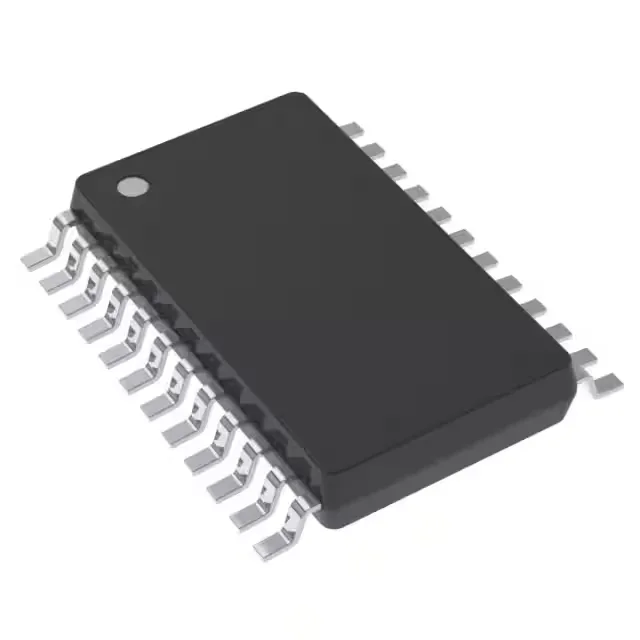
10 ns propagation delay — the speed ceiling for glue logic
The ATF22V10C-10XU is a 10 ns EE PLD from Microchip's 22V10 series, offering 10 registered macrocells in a 24-TSSOP package. It runs on a single 5 V supply and is programmed as an EE PLD, meaning it retains the configuration when power is removed and can be reprogrammed in-system or on a programmer. This speed grade — 10 ns pin-to-pin propagation delay — sets the maximum combinatorial logic throughput: at 10 ns, the part can handle clock frequencies up to roughly 100 MHz in registered mode, making it a fit for address decoding, state-machine control, and bus-interface logic in 5 V systems.
10 macrocells — what the logic budget buys
Ten macrocells each contain a sum-of-products combinatorial array and a configurable flip-flop (D/T/JK/SR). That is enough logic to replace a handful of 74-series TTL or 4000-series CMOS parts — a 3-to-8 decoder plus a 4-bit counter, for example — without the board area or power of discrete gate packages. The 22V10 architecture is industry-standard: any programmer that supports the JEDEC file format for the 22V10 family will program this part.
Microchip lists the ATF22V10C-10XU as active. For a BOM that already qualifies this PLD, the supply outlook is stable; for a new design, the active status removes the risk of a mid-lifecycle EOL notice during the product's first few years.
24-TSSOP footprint — board-level fit
The 24-TSSOP package (0.173-inch body width, 4.40 mm) has a 0.65 mm pin pitch. That is a standard surface-mount footprint — the same as many 24-pin TSSOP logic devices — so the board layout is shared with other 24-TSSOP parts in the 22V10 family.