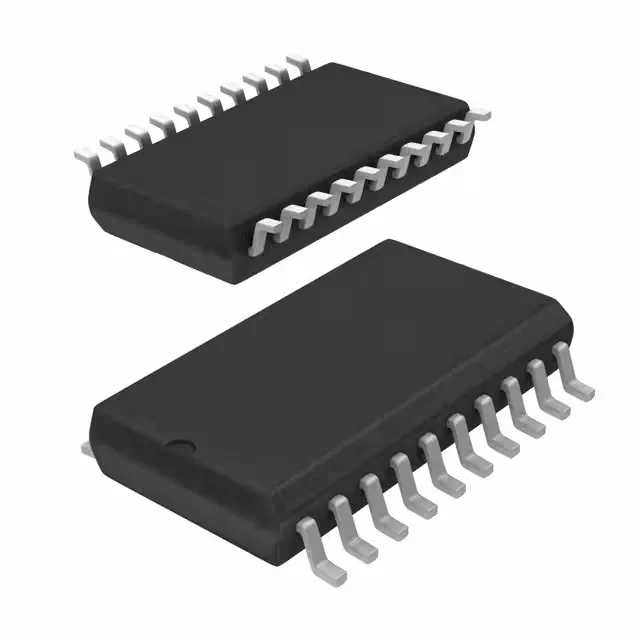
15 ns propagation delay — timing budget for glue logic
The ATF16V8CZ-15SU is a 5V EE PLD from Microchip's 16V8 series, offering 8 macrocells and a 15 ns propagation delay. That 15 ns speed grade sets the timing budget for address decoding, state-machine sequencing, or bus-interface logic in legacy 5V systems — it's fast enough for most 8- and 16-bit microprocessor buses running below 20 MHz, but tight for faster memory or peripheral access cycles.
5V-only supply — BOM constraint
This part operates at 5V only. No 3.3V or dual-supply option — if your board has migrated to a lower-voltage logic family, you'll need a level translator or a different PLD. The 5V rail also means the I/O thresholds are TTL-compatible on the input side, which mates cleanly with 5V CMOS and TTL legacy logic.
20-SOIC wide-body — footprint check
The package is a 20-SOIC with a 7.50 mm body width (0.295"). That's the wide-body SOIC, not the narrow 20-SOIC (typically 5.3 mm or 0.209"). If you're replacing a GAL16V8 or a narrow SOIC PLD, verify the board footprint matches the wider body — the pin pitch is still 1.27 mm, but the body width difference can cause clearance issues with adjacent components or edge connectors.
8 macrocells — logic capacity ceiling
Eight macrocells is the standard density for the 16V8 architecture — roughly equivalent to two 22V10s or a single 20V8. It's sized for small-scale combinatorial and registered logic: address decoders, bus arbiters, simple state machines, or replacing a handful of 7400-series SSI/MSI parts. If your logic equation set exceeds 8 registered outputs or 16 product terms per output, step up to a 22V10 or a CPLD with more macrocells.